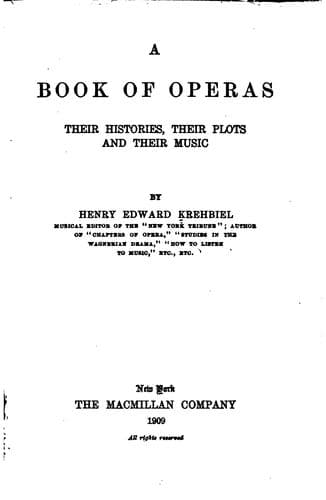
A Book of Operas: Their Histories, Their Plots, and Their MusicKrehbiel, Henry Edward
History
A Book of Operas: Their Histories, Their Plots, and Their Music
Krehbiel, Henry Edward
Operas -- Stories, plots, etc.
We reach the last act of the drama. Radames is to be tried for
treason in having betrayed a secret of war to his country's enemy.
Amneris fain would save him were he to renounce Aïda and accept her
love. She offers on such terms to intercede for him with her father,
the king. From her Radames learns that Aïda escaped the guards who
slew her father. He is resolute to die rather than prove faithless
to her, and is led away to the subterranean trial chamber. Amneris,
crouched without, hears the accusing voices of the priests and the
awful silence which follows each accusation; for Radames refuses to
answer the charges. The priests pronounce sentence:--Burial alive!
Amneris hurls curses after them, but they depart, muttering, "Death
to the traitor!"
Radames is immured in a vault beneath the temple of Vulcan, whose
sacred priestesses move in solemn steps above, while he gropes in
the darkness below. Never again shall light greet his eyes, nor
sight of Aïda. A groan. A phantom rises before him, and Aïda is at
his side. She had foreseen the doom of her lover, and entered the
tomb before him to die in his arms. Together they say their farewell
to the vale of tears, and their streaming eyes have a prevision of
heaven. Above in the temple a figure, shrouded in black, kneels
upon the stone which seals the vault and implores Isis to cease her
resentment and give her adored one peace. It is Amneris.
CHAPTER XI
"DER FREISCHUTZ"
A description of Carl Maria von Weber's opera, "Der Freischütz,"
ought to begin with a study of the overture, since that marvellous
composition has lived on and on in the concert-rooms of the world
without loss of popularity for nearly a century, while the opera
which it introduces has periodically come and gone according to
popular whim or the artistic convictions or caprices of managers in
all the countries which cultivate opera, except Germany. Why Germany
forms an exception to the rule will find an explanation when the
character of the opera and its history come under investigation.
The overture, notwithstanding its extraordinary charm, is only an
exalted example of the pot-pourri class of introductions (though
in the classic sonata form), which composers were in the habit of
writing when this opera came into existence, and which is still
imitated in an ignoble way by composers of ephemeral operettas. It
is constructed on a conventional model, and its thematic material is
drawn from the music of the opera; but, like the prelude to Wagner's
lyric comedy, "Die Meistersinger von Nürnberg," it presents the
contents of the play in the form of what many years after its
composition came to be called a symphonic poem, and illustrates the
ideal which was in Gluck's mind when, in the preface to "Alceste,"
he said, "I imagined that the overture ought to prepare the audience
for the action of the piece, and serve as a kind of argument to it."
The atmosphere of the opera is that which pervades the sylvan life
Public-domain text, read in full here on John Shaqi.
Reviews
Reviews
No reviews yet
Be the first to share your thoughts on this work.
Elsewhere in the archive
Join the Discussion
Join the discussion
Sign in to leave a comment or review.
Sign InorCreate an account