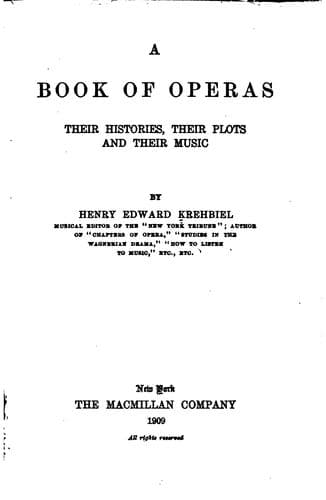
A Book of Operas: Their Histories, Their Plots, and Their MusicKrehbiel, Henry Edward
History
A Book of Operas: Their Histories, Their Plots, and Their Music
Krehbiel, Henry Edward
Operas -- Stories, plots, etc.
Though there are a dozen different points of view from which Weber's
opera "Der Freischütz" is of fascinating interest, it is almost
impossible for any one except a German to understand fully what the
opera means now to the people from whose loins the composer sprung,
and quite impossible to realize what it meant to them at the time of
its production. "Der Freischütz" is spoken of in all the handbooks
as a "national" opera. There are others to which the term might
correctly and appropriately be applied--German, French, Italian,
Bohemian, Hungarian, Russian; but there never was an opera, and
there is no likelihood that there ever will be one, so intimately
bound up with the loves, feelings, sentiments, emotions,
superstitions, social customs, and racial characteristics of a
people as this is with the loves, feelings, sentiments, emotions,
superstitions, social customs, and racial characteristics of the
Germans. In all its elements as well as in its history it is
inextricably intertwined with the fibres of German nationality. It
could not have been written at another time than it was; it could
not have been written by any other composer living at that time;
it could not have been conceived by any artist not saturated with
Germanism. It is possible to argue one's self into a belief of
these things, but only the German can feel them. Yet there is no
investigator of comparative mythology and religion who ought not to
go to the story of the opera to find an illustration of one of the
pervasive laws of his science; there is no folklorist who ought not
to be drawn to its subject; no student of politics and sociology who
cannot find valuable teachings in its history; no critic who can
afford to ignore its significance in connection with the evolution
of musical styles and schools; no biographer who can fail to observe
the kinship which the opera establishes between the first operatic
romanticist and him who brought the romantic movement to its
culmination; that is, between Carl Maria von Weber and Richard
Wagner. It is even a fair subject for the study of the scientific
psychologist, for, though the story of the opera is generally
supposed to be a fanciful structure reared on a legendary
foundation, it was a veritable happening which gave it currency a
century ago and brought it to the notice of the composer; and this
happening may have an explanation in some of the psychical phenomena
to which modern science is again directing attention, such as
hypnotism, animal magnetism, and the like.
Public-domain text, read in full here on John Shaqi.
Reviews
Reviews
No reviews yet
Be the first to share your thoughts on this work.
Elsewhere in the archive
Join the Discussion
Join the discussion
Sign in to leave a comment or review.
Sign InorCreate an account