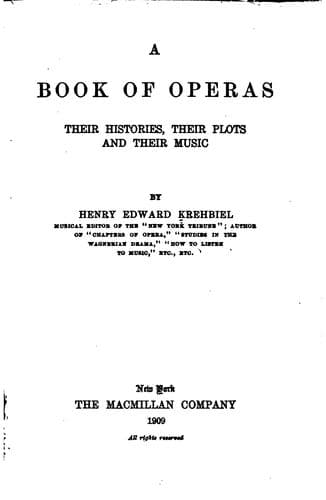
A Book of Operas: Their Histories, Their Plots, and Their MusicKrehbiel, Henry Edward
History
A Book of Operas: Their Histories, Their Plots, and Their Music
Krehbiel, Henry Edward
Operas -- Stories, plots, etc.
From the story drawn from the records of the Bohemian law court, it
is plain that to make a compact with the Wild Huntsman was a much
more gruesome and ceremonious proceeding than that which took place
between Faust and the Evil One in the operas of Gounod and Boito.
In both these instances a scratch of the pen sufficed, and the
deliberations which preceded the agreement were conducted in a
decorous and businesslike manner. But to invoke Samiel and obtain
his gifts was a body, mind, and nerve-racking business. In some
particulars the details differed a little from those testified to by
the Bohemian clerk. In the first place, the Devil's customer had to
repair to a crossroads of a Friday between midnight and one o'clock
when the moon was in an eclipse and the sun in Sagittarius. If in
such a place and at such a time he drew a circle around himself with
his hunting-spear and called "Samiel!" three times, that worthy
would appear, and a bargain might be driven with him for his wares,
which consisted of seven magical bullets ("free bullets," they were
called), which were then cast under the eye of the Evil One and
received his "blessing." The course of six of them rested with the
"free shooter," but the seventh belonged to Samiel, who might direct
it wheresoever he wished. The price of these bullets was the soul of
the man who moulded them, at the end of three years; but it was the
privilege of the bondsman to purchase a respite before the
expiration of the period by delivering another soul into the
clutches of the demon.
Weber used all these details in his opera, and added to them the
fantastic terrors of the Wild Hunt and the Wolf's Glen. Of this
favored abode of the Evil One, Wagner gave a vivid description in an
essay on "Der Freischütz" which he wrote for the Gazette musicale in
May, 1841, when the opera was preparing, under the hand of Berlioz,
for representation at the Grand Opéra in Paris. Wagner's purpose in
writing the essay was to acquaint the Parisians with the contents
and spirit of the piece, make them understand its naïve Teutonism,
and also to save it from the maltreatment and mutilation which he
knew it would have to suffer if it were to be made to conform to
the conventions of the Académie. He wanted to preserve the spoken
dialogue and keep out the regulation ballet, for the sake of which
he had to make changes in his "Tannhäuser" twenty years later. He
failed in both efforts, and afterward wrote an account of the
performance for a German newspaper, which is one of the best
specimens of the feuilleton style which his sojourn in Paris
provoked. There was no need of telling his countrymen what the
Wolf's Glen was, for it had been the most familiar of all scenes in
the lyric theatres of Germany for a score of years, but for the
Parisians he pictured the place in which Weber's hero meets Samiel
very graphically indeed:--
Public-domain text, read in full here on John Shaqi.
Reviews
Reviews
No reviews yet
Be the first to share your thoughts on this work.
Elsewhere in the archive
Join the Discussion
Join the discussion
Sign in to leave a comment or review.
Sign InorCreate an account