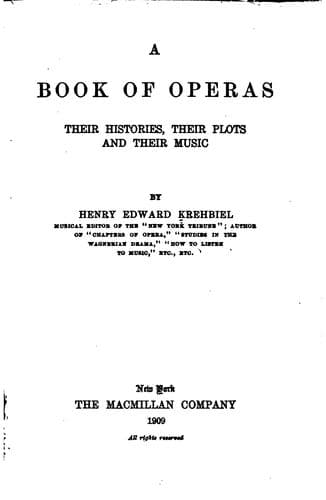
A Book of Operas: Their Histories, Their Plots, and Their MusicKrehbiel, Henry Edward
History
A Book of Operas: Their Histories, Their Plots, and Their Music
Krehbiel, Henry Edward
Operas -- Stories, plots, etc.
A scurry, like the sound of the wild hunt, and speedily the storm
is laid. Merely a wanton whir still pulses in the breeze, a wave
of weird voluptuousness, like the sensuous breath of unblest love,
still soughs above the spot where impious charms had shed their
raptures and over which the night now broods once more. But dawn
begins to break; already from afar is heard again the pilgrims'
chant. As this chant draws closer and closer, as the day drives
farther back the night, that whir and soughing of the air--which had
erewhile sounded like the eerie cry of souls condemned--now rises to
ever gladder waves, so that when the sun ascends at last in splendor
and the pilgrims' chant proclaims in ecstasy to all the world, to
all that live and move thereon, salvation won, this wave itself
swells out the tidings of sublimest joy. 'Tis the carol of the
Venusberg itself redeemed from curse of impiousness, this cry we
hear amid the hymn of God. So wells and leaps each pulse of life in
chorus of redemption, and both dissevered elements, both soul and
senses, God and nature, unite in the atoning kiss of hallowed love.
This description of the poetical contents of the overture to
"Tannhäuser" applies to the ordinary form of the introduction to
the opera which was used (and still is in many cases) until Wagner
revised the opera for performance in Paris in 1861. The traditions
of French opera called for a ballet in the third act. Wagner was
willing to yield to the desire for a ballet, but he could not place
it where the habits of the opera-going public demanded it. Instead,
he remodelled the overture and, sacrificing the coda which brought
back a return of the canticle of the pilgrims, he lengthened the
middle portion to fit an extended choreographic scene, and with it
led into the opera without a break. The neglect to provide a ballet
in the usual place led to a tremendous disturbance in which the
Jockey Club took the lead. Wagner's purpose in the extended portion
of the overture now called the "Bacchanale" may be read in his
stage-directions for the scene.
Public-domain text, read in full here on John Shaqi.
Reviews
Reviews
No reviews yet
Be the first to share your thoughts on this work.
Elsewhere in the archive
Join the Discussion
Join the discussion
Sign in to leave a comment or review.
Sign InorCreate an account