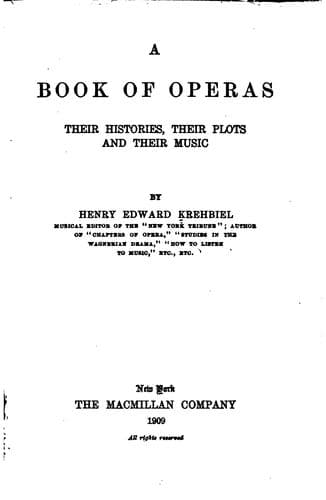
A Book of Operas: Their Histories, Their Plots, and Their MusicKrehbiel, Henry Edward
History
A Book of Operas: Their Histories, Their Plots, and Their Music
Krehbiel, Henry Edward
Operas -- Stories, plots, etc.
it was abandoned as "impossible."
The next year saw the turning-point in Wagner's career. Ludwig
of Bavaria invited him to come to Munich, the political ban was
removed, and "Tristan und Isolde" had its first performance, to the
joy of the composer and a host of his friends, on June 10, 1865, at
the Royal Court Theatre of the Bavarian capital, under the direction
of Hans von Bölow. The rôles of Tristan and Isolde were in the hands
of Ludwig Schnorr von Carolsfeld and his wife. Albert Niemann was
prevented by the failure of the Strasburg plan from being the first
representative of the hero, but to him fell the honor of setting the
model for all American representations. The first performance in the
United States took place in the Metropolitan Opera-house on December
1, 1886, under the direction of Anton Seidl. The cast was as
follows: Isolde, Lilli Lehmann; Brangäne, Marianne Brandt; Tristan,
Albert Niemann; Kurwenal, Adolf Robinson; König Marke, Emil Fischer;
Melot, Rudolph von Milde; ein Hirt, Otto Kemlitz; ein Steuermann,
Emil Saenger; ein Seemann, Max Alvary.
Two circumstances bid us look a little carefully into the
instrumental prelude with which Wagner has prefaced his drama. One
is that it has taken so prominent a place in the concert-room that
even those whose love for pure music has made them indifferent to
the mixed art-form called the opera ought to desire acquaintance
with its poetical and musical contents; the other is that the
prelude, like the overture to "Fidelio" known as "Leonore No. 3,"
presents the spiritual progress of the tragedy from beginning to
end to the quickened heart and mind of the listener freed from all
material integument. To do this it makes use of the themes which are
most significant in the development of the psychology of the drama,
which is far and away its most important element, for the pictures
are not many, and the visible action is slight. Listening to the
music without thought of the drama, and, therefore, with no purpose
of associating it with the specific conceptions which later have
exposition in the text, we can hear in this prelude an expression
of an ardent longing, a consuming hunger,
which doth make
The meat it feeds on,
a desire that cannot be quenched, yet will not despair. Then, at the
lowest ebb of the sweet agony, an ecstasy of hope, a wildly blissful
contemplation of a promise of reward. If I depart here for a brief
space from my announced purpose not to analyze the music in the
manner of the Wagnerian commentators, it will be only because the
themes of the prelude are the most pregnant of those employed in the
working out of the drama, because their specific significance in the
purpose of the composer is plainly set forth by their association
with scenes and words, and because they are most admirably fitted
by structure and emotional content to express the things attributed
to them. The most important of the themes is that with which the
prelude begins:--
[Musical excerpt]
Public-domain text, read in full here on John Shaqi.
Reviews
Reviews
No reviews yet
Be the first to share your thoughts on this work.
Elsewhere in the archive
Join the Discussion
Join the discussion
Sign in to leave a comment or review.
Sign InorCreate an account