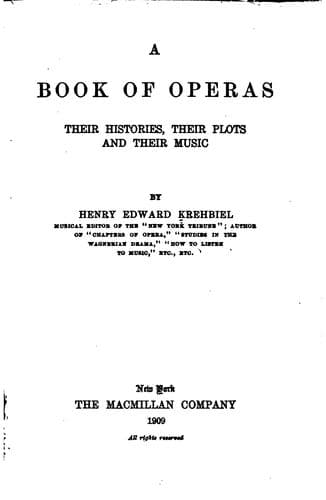
A Book of Operas: Their Histories, Their Plots, and Their MusicKrehbiel, Henry Edward
History
A Book of Operas: Their Histories, Their Plots, and Their Music
Krehbiel, Henry Edward
Operas -- Stories, plots, etc.
There is but a single scene in "The Court of Venus." In other plays
written in after years, no matter how often the action demanded it,
there is neither change of scenes nor division into acts; and the
personages, whether Biblical or classical, talk in the manner of
the simple folk of the sixteenth century. Sachs's tragedy, "Von der
strengen Lieb' Herrn Tristrant mit der schönen Königin Isalden" ("Of
the strong love of Lord Tristram and the beautiful Queen Iseult"),
contains seven acts, as is specified in the continuation of the
title "und hat sieben Akte." It was written thirty-six years later
than the carnival play and three years after the establishment of
a theatre in Nuremberg by the mastersingers. Each act ends with a
triple rhyme. Though Sachs uses stage directions somewhat freely
compared with the other dramatists of the period, the personages
all speak in the same manner, and time and space are annihilated in
the action most bewilderingly. Thus, no sooner does Herr Tristrant
volunteer to meet Morhold der Held to settle the question of
"Curnewelshland's" tribute to "Irland" than the two are at it hammer
and tongs on an island in the ocean. All the other incidents of the
old legends follow as fast as they are mentioned. Tristrant saves
his head in Ireland when discovered as the slayer of Morhold by
ridding the country of a dragon, and is repeatedly convicted of
treachery and taken back into confidence by König Marx, as one may
read in Sir Thomas Malory's "Morte d'Arthur." Sachs follows an old
conclusion of the story and gives Tristrant a second Iseult to wife,
and she tells the lie about the sails. The first Iseult dies of a
broken heart at the sight of her lover's bier, and the Herald in a
speech draws the moral of the tale:--
Aus dem so lass dich treulich warnen,
O Mensch, vor solcher Liebe Garnen,
Und spar dein Lieb' bis in die Eh',
Dann hab' Ein lieb' und keine meh.
Diesselb' Lieb' ist mit Gott und Ehren,
Die Welt damit fruchtbar zu mehren.
Dazu giebt Gott selbst allewegen
Sein' Gnad' Gedeihen und milden Segen.
Dass stete Lieb' und Treu' aufwachs'
Im ehlich'n Stand', das wünscht Hans Sachs.
One of the most thrilling scenes in "Die Meistersinger" is the
greeting of Hans Sachs by the populace when the hero enters with the
mastersingers' guild at the festival of St. John (the chorus, "Wach'
auf! es nahet gen den Tag"). Here there is another illustration of
Wagner's adherence to the verities of history, or rather, of his
employment of them. The words of the uplifting choral song are not
Wagner's, but were written by the old cobbler-poet himself. Wagner's
stage people apply them to their idol, but Sachs uttered them in
praise of Martin Luther; they form the beginning of his poem
entitled "The Wittenberg Nightingale," which was printed in 1523.
Public-domain text, read in full here on John Shaqi.
Reviews
Reviews
No reviews yet
Be the first to share your thoughts on this work.
Elsewhere in the archive
Join the Discussion
Join the discussion
Sign in to leave a comment or review.
Sign InorCreate an account