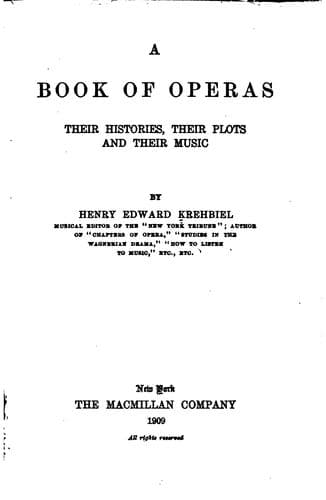
A Book of Operas: Their Histories, Their Plots, and Their MusicKrehbiel, Henry Edward
History
A Book of Operas: Their Histories, Their Plots, and Their Music
Krehbiel, Henry Edward
Operas -- Stories, plots, etc.
While emphasizing this fact, however, it is well not to forget that
in turning to the literature of folklore for an operatic subject
Humperdinck was only carrying out one of the principles for which
Wagner contended. The Mährchen of a people are quite as much a
reflex of their intellectual, moral, and emotional life as their
heroic legends and myths. In fact, they are frequently only the
fragments of stories which, when they were created, were embodiments
of the most profound and impressive religious conceptions of which
the people were capable. The degeneration of the sun god of our
Teutonic forefathers into the Hans of Grimm's tale, who could not
learn to shiver and shake, through the Sinfiotle of the "Volsunga
Saga" and the Siegfried of the "Nibelungenlied," is so obvious that
it needs no commentary. Neither should the translation of Brynhild
into Dornröschen, the Sleeping Beauty of our children's tales.
The progress illustrated in these examples is that from myth to
Mährchen, and Humperdinck in writing his fairy opera, or nursery
opera if you will, paid tribute to German nationality in the same
coin that Wagner did when he created his "Ring of the Nibelung."
Everything about "Hänsel und Gretel" is charming to those who can
feel their hearts warm toward the family life and folklore of
Germany, of which we are, or ought to be, inheritors. The opera
originated, like Thackeray's delightful fireside pantomime for great
and small children, "The Rose and the Ring." The composer has a
sister, Frau Adelheid Wette, wife of a physician in Cologne. She,
without any particular thought of literary activity, had been in
the habit of writing little plays for production within the family
circle. For these plays her brother provided the music. In this way
grew the first dramatic version of the story of Hänsel and Gretel,
which, everybody who has had a German nurse or has read Grimm's
fairy tales knows, tells the adventures of two children, a brother
and sister, who, driven into the woods, fell into the toils of the
Crust Witch (Knusperhexe), who enticed little boys and girls into
her house, built of gingerbread and sweetmeats, and there ate them
up. The original performers of the principal characters in the play
were the daughters of Frau Wette. Charmed with the effect of the
fanciful little comedy, Herr Humperdinck suggested its expansion
into a piece of theatrical dimensions; and the opera was the result.
It was brought forward for the first time in public on December 23,
1893, in Weimar, and created so profound an impression that it
speedily took possession of all the principal theatres of Germany,
crossed the channel into England, made its way into Holland,
Belgium, and Italy, and reached America within two years. Its first
performance in New York was in an English version at Daly's Theatre
on October 8, 1895. There were drawbacks in the representation which
prevented a success, but after it had been incorporated in the
Public-domain text, read in full here on John Shaqi.
Reviews
Reviews
No reviews yet
Be the first to share your thoughts on this work.
Elsewhere in the archive
Join the Discussion
Join the discussion
Sign in to leave a comment or review.
Sign InorCreate an account