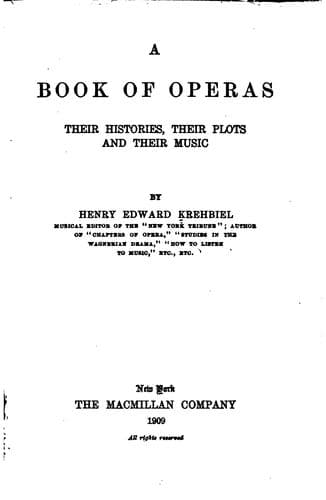
A Book of Operas: Their Histories, Their Plots, and Their MusicKrehbiel, Henry Edward
History
A Book of Operas: Their Histories, Their Plots, and Their Music
Krehbiel, Henry Edward
Operas -- Stories, plots, etc.
"Sandman has been here," says Hänsel, sleepily; "let us say our
evening blessing." They kneel and repeat the prayer to the melody
which has been called the "Prayer Theme," then go to sleep in each
other's arms. All has been dark. Now a bright light pierces the
mist, which gathers itself into a cloud that gradually takes the
shape of a staircase reaching apparently from heaven to earth. The
orchestra plays a beautiful and extended piece of music, of which
the principal melodic material is derived from the themes of
"Prayer" and "Promise," while seven pairs of angels descend the
cloud-stairs and group themselves about the little sleepers, and
a golden host extends upward to the celestial abode. By this time
the scene is filled with a glory of light, and the curtain closes.
The greater part of the dramatic story is told in, the third act.
The opening of the curtain is preceded by a brief instrumental
number, the principal elements of which are a new theme:--
[Musical excerpt]
and the "Theme of Fulfilment." The significance of the latter in
this place is obvious: the promised benison to the children has
been received. The former theme is a pretty illustration of what
has already been said of Humperdinck's consistent devotion to the
folk-song spirit in his choice of melodies. The phrase has an
interrogatory turn and is, in fact, the melody of the mysterious
question which comes from the house of the Witch a few minutes
later, when the children help themselves to some of the toothsome
material out of which the magic structure is built:--
[Musical excerpt--"Nibble, nibble, mouskin, Who's nibbling at my
housekin?"]
Simple as this little phrase is, it is yet a draught from a
song-game that comes nigh to being universal. No phrase is more
prevalent among nursery songs than that made up of the first six
notes. The original German song itself has come down to American and
English children, and enthusiastic folklorists see in it a relic
of the ancient tree worship and an invocation of Frau Holda, the
goddess of love and spring of our Teutonic ancestors. It is the
first phrase of the German, "Ringel, ringel, reihe," which our
children know as "Ring around a rosy." It was an amiable conceit of
the composer's to put such a tune into the mouth of the Witch at a
moment of terror in the play. By it he publishes his intention
not to be too utterly gruesome in his treatment of the hag. This
intention, moreover, he fulfils in the succeeding scene. The Witch
appears weird and wicked enough in appearance, in her discordant
laugh, and the instrumental delineation of her, but when she sings
to the children, she is almost ingratiating. Of course, she is
seeking to lure them to a horrible fate, but though she does not
deceive them for even a moment, her musical manner is much like
theirs, except when she is whirling through the air on a broomstick.
Public-domain text, read in full here on John Shaqi.
Reviews
Reviews
No reviews yet
Be the first to share your thoughts on this work.
Elsewhere in the archive
Join the Discussion
Join the discussion
Sign in to leave a comment or review.
Sign InorCreate an account