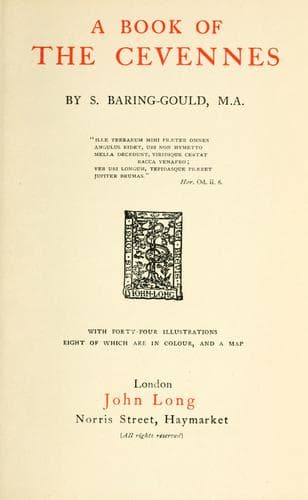
Cévennes Mountains (France); France -- Description and travel
The river Dunière sweeps past Vernoux, and the road from S. Fortunat to
this town presents a succession of striking scenes. The gorge through
which the Dunière enters the Erieux has precipitous sides, above which
the mountains rise bare, or but meagrely dotted with evergreen oaks,
that grow low and stunted. Below rolls, leaps, and foams the torrent.
In the contracted throat of Pontpierre, after the bursting of storms in
the Cévennes, the water rises and writhes to escape, and issues from
it into the valley of the Erieux as from a spout. The road follows the
edge of the chasm as far as Roumézoux, after which the hills fall back
and allow of cultivation. Then again they contract, but the gorge is
less savage, and is commanded on the left bank by one of the noblest
ruins in the Vivarais. The Dunière flowing from the east receives a
torrent descending from the north, and at this point rises a mighty
crag on the top of which two lofty towers stand out sharply against
the sky. They belong to the castle of La Tourette, close to Vernoux.
According to popular tradition it was built by the Saracens; it was
the feudal centre of the district and occupied by a Marquess de La
Tourette. The castle was intact till the Revolution, and was a scene of
much hospitality extended to the bourgeoisie of Vernoux, who danced in
the great hall, hung with stamped and gilded leather. At the Revolution
the castle was unroofed and ruin set in rapidly, as every one who
wanted to build a pigsty or a factory used its walls as a quarry.
Happily of late years the family of La Tourette, that has its residence
at Tournon, has repurchased the eagle nest of its ancestors and has
put a stop to the destruction. From its isolated rock the castle was
connected by a drawbridge with a terrace, beyond which was the farm,
a building of the sixteenth century, that had not been molested. The
terrace is sustained by a wall and was originally planted with trees,
and must have been a delightful walk, suspended above the precipice,
and from which one could look down on the birds of prey darting and
fluttering in the depths, and which also had their habitations in these
rocks.
In 1671, the Marquess de La Tourette bought the barony of Chalençon to
the south of Vernoux. This was at one time one of the most powerful
baronies in the country. It extended its jurisdiction over eighty
parishes, all of which were bound to furnish men-at-arms when summoned
to do so by the Seigneur of Chalençon.
Public-domain text, read in full here on John Shaqi.
Reviews
Reviews
No reviews yet
Be the first to share your thoughts on this work.
Elsewhere in the archive
Join the Discussion
Join the discussion
Sign in to leave a comment or review.
Sign InorCreate an account