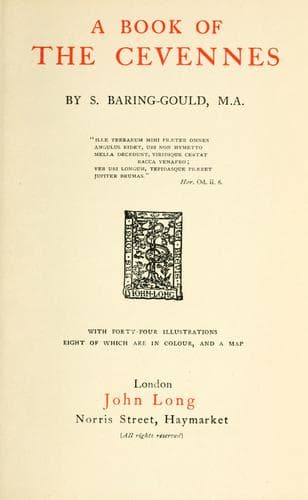
Cévennes Mountains (France); France -- Description and travel
However, it was not given to him to see the realisation of his schemes.
The imperial police had sent two emissaries to London, who managed
to seduce Lorenzo, the Italian valet of the Count, and through him
to obtain notes and despatches which his master was preparing for
transmission to the Cabinet of the Prime Minister. On July 22nd, 1812,
the Count d'Antraigues having expressed his intention to visit the
Prime Minister to obtain his opinion on a certain memoir, Lorenzo,
who had purloined it and committed it to the spies of Napoleon that
they might make a transcript of it, saw that his faithlessness was at
the point of being discovered. Then he resolved on killing his master
and mistress and on blowing out his own brains.
This he did. Such was the version of the story as given in the English
newspapers. The only witness to the murder was the Count's coachman.
The circumstances of the assassination and suicide were never sifted;
the whole matter was hushed up; and it became a matter of mutual
recrimination between the French and English Governments, each casting
on the other the blame of the murder of this miserable man—a man
without a respectable quality.
The name of Antraigues is taken from its position, Inter Aquæ, between
the three streams—the Volane, the Bise, and the Mas.
[Illustration: FALL AT ANTRAIGUES]
On August 16th, the fête of S. Roch, a great pilgrimage is made to
Antraigues, attended by many thousand persons. The neighbouring
villages send their processions with clergy, crosses, and banners
waving. The bells of Antraigues clash merrily. The whole bourg is in
gala costume. At nine o'clock a.m. all the processions unite and form
one long, many-coloured, winding line that creeps up the hill towards
the chapel of S. Roch, hid among chestnut trees. The path is rough,
stony, sun-scorched. At intervals are little shrines constructed of
boughs and adorned with flowers, roses, broom, lavender. In each of
these is a little girl dressed in white with a chaplet on her head,
holding a scroll that bears an inscription in honour of the patron
saint, lavishing on him every possible expression of love and respect.
The procession advances, now murmuring a litany, now breaking into
hymn, and in the rear come the clergy in white, with the blue smoke of
incense rising and spreading in the clear summer air.
On reaching the chapel the pilgrims separate their files to allow the
ecclesiastics to pass. The priest ascends to the altar for Mass, and
the crowd falls into a living stair along the slope of the mountain,
kneeling in ranges, some among the chestnut trees, athwart whose leaves
the sun shoots arrows of fire that make the white caps and the gold
chains of the women flash. The Mass ended, the procession descends in
the same order as that in which it mounted, and disperses. The second
scene is less edifying—it is changed to the cabaret, where the pilgrims
refresh themselves, and the men, in too many cases, carouse.
Public-domain text, read in full here on John Shaqi.
Reviews
Reviews
No reviews yet
Be the first to share your thoughts on this work.
Elsewhere in the archive
Join the Discussion
Join the discussion
Sign in to leave a comment or review.
Sign InorCreate an account