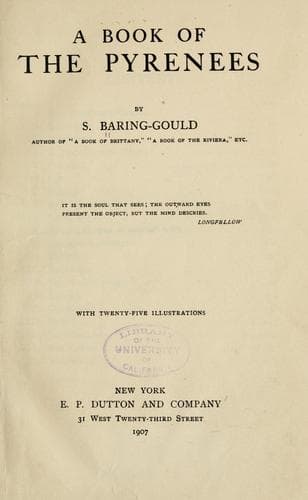
Legends -- Pyrenees; Pyrenees -- Description and travel; Pyrenees -- History
After the extinction of the Armagnacs, the overlordship passed to the
kings of France, and each and all from Louis XII to Louis XVI had to
recognize and allow their very extended privileges. From the year 1300
no seigneur could withdraw an inhabitant of the Four Valleys from the
jurisdiction of their own judges; every citizen could own land, marry,
create an industry, or carry on any trade without authorization. The
right to bear arms belonged to every one; and up to the eve of the
Revolution the Four Valleys were exempt from all war-tax and from the
obligation to have troops quartered on them.
La Fayette had no occasion to have gone to America to have seen what
republican self-government was. It existed at his doors.
CHAPTER XV
LUCHON
Montréjeau--A bastide--Grotto de Gargas--A cannibal--Blaise
Ferrage--Taken and escapes--Final capture--Execution--S.
Bertrand de Cominges--Sertorius--Gundowald--His coronation--
Treachery of Boso--And of Mummolus--Murder of Gundowald--
Destruction of the city--Bishops at Valcabrères--Church of
S. Juste--Bertrand de l’Isle-Jourdain rebuilds the town--
Bertrand de Got--Jubilee--The cathedral--Nonresident bishops--
Counts of Cominges--Murder of a boy husband--Imprisonment of
the Countess Margaret--Bequeaths the county to the Crown of
France--The Garonne-Bagnères de Luchon--Its visitors--Its
antiquity--Lac de Seculéjo--Description by Inglis--Cures for
all disorders--_Le Maudit_--S. Aventin and the bear--Val de
Lys--Val d’Aran--S. Béat and its quarries--The valley should
belong to France--Viella--The Maladetta--Trou de Toro--Port
de Venasque.
At Montréjeau the line branches off to Bagnères de Luchon from the
trunk to Toulouse. Montréjeau was Montroyal, then Montreal, and then
what it has now become through deformation by the Gascon tongue. It was
a bastide, one of those artificial towns, created first by Edward I,
and then copied by great nobles, and by the kings of France, in which
every street was either parallel to another, or cut it at right angles;
and the houses were built in blocks, the whole surrounded by walls, and
the church usually serving as part of the fortification.
Public-domain text, read in full here on John Shaqi.
Reviews
Reviews
No reviews yet
Be the first to share your thoughts on this work.
Elsewhere in the archive
Join the Discussion
Join the discussion
Sign in to leave a comment or review.
Sign InorCreate an account