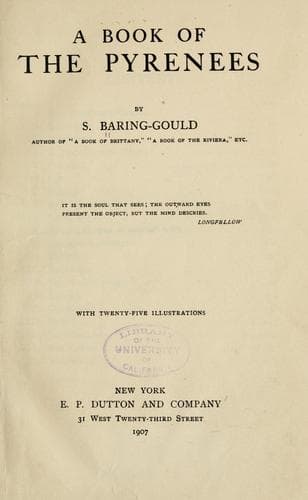
Legends -- Pyrenees; Pyrenees -- Description and travel; Pyrenees -- History
About 928 Miro, Count of Barcelona, gave Cerdagne to his son Oliba
Cabréta, and it was ruled by its own counts till 1117, when the last
died childless, and then it was reannexed to the county of Barcelona,
and later went to Aragon. Finally, by the peace of 1659, it was
divided, much to the indignation of the inhabitants, who protested
ineffectually--half went to France, and half remained to Spain. France
thrust her frontier down the Spanish slope of the mountains, taking
in the rivers that flow south to feed the Ebro, just as Spain carried
her frontier beyond the highest crests of the range to include the Val
d’Aran and the head waters of the Garonne. But this acquisition on the
part of France was not as unreasonable as it would seem, for the object
was to secure communication between Foix and the Conflant and Valespir
valleys that opened unto the plain of Roussillon, which had also become
incorporated into the kingdom of France.
There is, however, a curious little _enclave_ of twelve square
kilometres, about the town of Llivia, completely surrounded by French
territory, that remains Spanish. The explanation of this anomaly is
as follows: At the Peace of the Pyrenees Spain agreed to surrender
to France thirty-three villages in Cerdagne. But Llivia haughtily
protested that she was not a village, but a town, once a city with
a bishop of her own, consequently did not come within the terms
of the agreement. This was admitted, and Llivia remains Spanish,
much to the inconvenience of the custom-house officers, who have to
maintain a cordon of douaniers about the petty territory. Now Llivia,
that possesses 330 inhabitants, regrets the past. Spain exacts of
her taxes to the amount of 30,000 francs, and gives her nothing in
return--neither a post office, nor telegraph, nor roads. The post
office has to be kept up by the citizens, so also the roads till they
reach the frontier. Llivia was a Roman town founded in honour of the
wife of Augustus, and some remains of the Roman walls exist. It is a
poor, decayed place. A castle in ruins occupies the highest point of
the hill on which it is built; the large church is planted on a terrace
above the cold, slated roofs of the sordid houses and narrow streets of
the town.
Cerdagne is the country of the Ceretani of Pliny, and the same people
occupied the Valespir, and have left their name in the town of Ceret.
The race was not Iberic, but purely Celtic, and their name is the same
as that given to Ceretica, or Ceredigion, Cardigan in Wales.
Public-domain text, read in full here on John Shaqi.
Reviews
Reviews
No reviews yet
Be the first to share your thoughts on this work.
Elsewhere in the archive
Join the Discussion
Join the discussion
Sign in to leave a comment or review.
Sign InorCreate an account