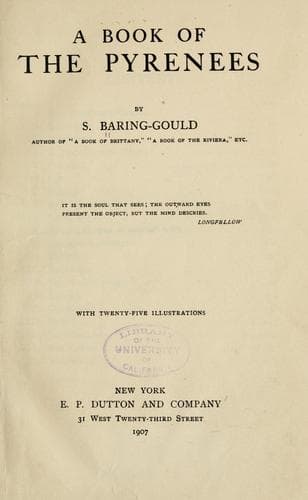
Legends -- Pyrenees; Pyrenees -- Description and travel; Pyrenees -- History
As soon as the vessel bearing the relics arrives at the quay, the
harbour-master calls out, “What boat is that?” To which the captain
replies, “A boat of Saint Vincent.” “Whence come you?” “From Saint
Vincent-de-l’Ile.” “With what are you laden?” “With the relics of the
Saint Vincent, of Saint Marinus, and of Saint Liberada.” “Are there
passengers, and are they according to rule?” “There are passengers, and
they are all according to rule.” “What do you require?” “To be allowed
to disembark.” “In the name of God, do so.”
Then the whole crowd shouts, “Sant Vincens béneit!” Whereupon the boat
is hauled ashore and dragged through the town. The crowd that separated
to allow of the passage then unites and follows in a dense mass,
elbowing one another. The boat halts before the “Vierge des quatres
coins,” the relics are removed from it, and carried processionally to
the church. The bonfire and the coloured lamps go out, and the scene
of movement is transferred from the harbour to the Place, where the
_joglars_, installed on an improvized platform, sound their instruments
to lively melodies, and all, young and old, in two minutes are in
full swing of a dance, that lasts from ten o’clock to midnight. “Si
réellement,” says a French writer, “la danse est un amusement, nulle
part au monde ou ne s’amuse autant qu’ ici.”
The train, as it traverses the flats and athwart arms of the lagoons
that lie along the coast, skirts a place called Salses, and if the
traveller be looking out of the window on the right hand, he catches
a glimpse of a rusty mass of building with towers, and wonders what
it is. This is the fortress of Salses, erected in 1497 by a Spanish
engineer named Ramirez, and it is sufficiently curious to merit a
study, for it was built at a time when the use of cannon was materially
altering the conditions of warfare, especially of sieges. The château,
though often menaced with destruction, indeed repeatedly ordered to
be levelled, has remained almost intact to the present day. It forms
a rectangle with a tower at each angle. These towers give evidence of
the hesitation of the engineer. He was hampered by tradition, and had
to introduce them without knowing exactly that they had a purpose any
longer. But, on the other hand, he adopted an innovation, destined to
revolutionize the defence of fortresses, by creating bastions isolated
and in advance of the walls, like the demi-lunes of modern citadels. As
far as we know, this was the first instance of their being employed.
The castle was of some strategic importance, as commanding the passage
between the vast Lagoon of Leucate and the barren ridge of the
Corbières.
Public-domain text, read in full here on John Shaqi.
Reviews
Reviews
No reviews yet
Be the first to share your thoughts on this work.
Elsewhere in the archive
Join the Discussion
Join the discussion
Sign in to leave a comment or review.
Sign InorCreate an account