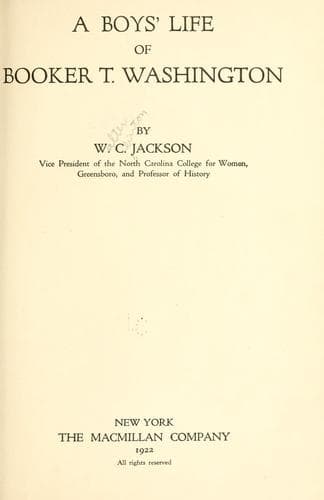
A boys' life of Booker T. WashingtonJackson, Walter Clinton
History
A boys' life of Booker T. Washington
Jackson, Walter Clinton
African American educators -- Biography -- Juvenile literature; Washington, Booker T., 1856-1915 -- Juvenile literature
He was not in doubt long as to what it meant to be a leader. One of the
first things that happened was the large number of invitations that came
to him to deliver addresses. These requests came from all parts of the
country and from all sorts of organizations. A very large number of
these invitations he was compelled to refuse. However, when he felt he
could serve his institution and his people, he always accepted. He
represented the Negro at the unveiling of the monument of R. G. Shaw, in
Boston; and at the Peace Convention in Chicago in 1898, at which time
President McKinley spoke. He attended most of the large religious
gatherings of his people throughout the country, and spoke before them.
Almost immediately there began to pour in on him a perfect flood of
letters from all parts of the country, from white and black, high and
low, rich and poor, asking a thousand different questions. Now it would
be a letter from a railroad president asking about some problem of
dealing with his employees; now from a school man asking about the
segregation of the races in schools. Again, from a legislator, asking
advice on some legislation; but principally the letters came from his
own people, asking all sorts of questions about a multitude of things.
One man wanted Washington to use his influence to secure the adoption of
a flag for the negro race; another wanted his backing for a patent
medicine that would take the curl out of the negro’s hair. Another
wanted to know if the negro race was dying out; another, if the race was
being blended with the white race; another, if he thought the negro was
being treated right politically. Perhaps the most remarkable request,
however, was from a woman, who wanted him to find her husband who had
deserted her some years before. And in order that he might be easily
identified she describes him: “This is the hith of him 5–6 light eyes
dark hair unwave shave and a Suprano Voice his age 58 his name
Steve.”[30]
To all of these letters he replied in the fullest and frankest and
kindest way.
Whenever there was race friction in the South, he was invariably called
upon either to go in person or to send a message. For example, when the
Atlanta riots occurred in 1906, Washington was in the North. He took the
first train South. He went among his own people in Atlanta first, and
then he went to the white people—to the Governor, the Mayor, the leading
citizens, ministers and merchants. Largely through his wise counsel and
efforts order was restored, and plans were made for the future.
As a spokesman for his people he wrote constantly for the press. Such
papers as the _Montgomery Advertiser_, the _Atlanta Constitution_, the
_New Orleans Picayune_, the Louisville _Courier Journal_, the Chicago
_Inter-Ocean_, and the Boston and New York papers gladly published his
articles. He also contributed frequent articles to the weekly journals,
such as _The Outlook_, and to the monthly magazines, such as _The
Century Magazine_.
Public-domain text, read in full here on John Shaqi.
Reviews
Reviews
No reviews yet
Be the first to share your thoughts on this work.
Elsewhere in the archive
Join the Discussion
Join the discussion
Sign in to leave a comment or review.
Sign InorCreate an account