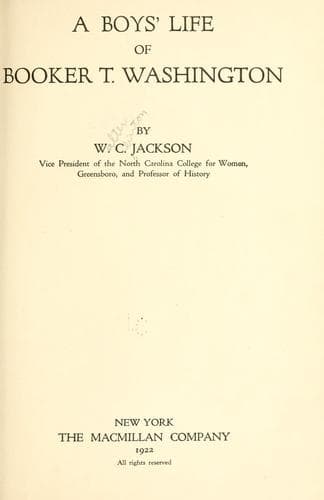
A boys' life of Booker T. WashingtonJackson, Walter Clinton
History
A boys' life of Booker T. Washington
Jackson, Walter Clinton
African American educators -- Biography -- Juvenile literature; Washington, Booker T., 1856-1915 -- Juvenile literature
Washington has done more for the education of the negro than any other
one man, white or black. His work at Tuskegee, his great educational
campaigns, and his speeches and writings have combined to make his
accomplishments of supreme value. Not only has he done this for the
negro, but his work has helped the cause of education for the white
people very greatly. All education in the South was backward. Like his
great teacher, General Armstrong, Washington realized that in their
progress the two races were bound together in the South, and that they
must grow or step backward together. It is impossible for the negro to
make his best progress unless the white man does so at the same time.
And of course this works both ways. Because he believed this, Washington
was anxious for school conditions for white people to change just as
well as the school conditions for negroes. Besides, he wanted all the
people to have the advantages of education. He did not hate anybody, and
consequently did not want anybody to be deprived of the best there was
in life. He did not want anybody, white or black, to fail to have his
best opportunity. So he worked for the advancement of the cause of the
white schools as well as the black, and his services to the white
schools were great.
The future of negro education is very bright. Schools and colleges are
being built every year. Better teachers are being prepared. Children are
going to school in larger numbers than ever before, and their work is
more satisfactory.
Every year the states appropriate more and more money for negro
education. The negro is now able to pay a large part of the cost of his
own education, and he is very willingly doing so.
The negro is determined to get an education. When he gets it, he will be
a better citizen. And the better the citizens of a country are, the
better life is in every way, and the more completely are all our
problems solved.
CHAPTER XII
LEADING HIS PEOPLE
Immediately following Washington’s great speech in Atlanta in 1895,
there came the statement from all parts of the country, “Here is the new
leader of the negro race.” During the last years of slavery, and the
Civil War, and on for years after the war, Frederick Douglass, as has
been said, was the acknowledged leader of the negro in the United
States. Douglass had died in the early part of the year 1895. It seemed
that this man Washington had been raised up to take his place. The
Atlanta speech continued to be a topic of discussion throughout the
country, and coupled with this discussion was invariably the statement
that here was the new leader of the race.
Washington says that he was at a great loss to know what people meant
when they referred to him as the leader of his people. Of course, this
leadership was not a thing that he had sought. The people thrust this
duty upon him, and of course no man has a right to shun or dodge
responsibility that is thus bestowed.
Public-domain text, read in full here on John Shaqi.
Reviews
Reviews
No reviews yet
Be the first to share your thoughts on this work.
Elsewhere in the archive
Join the Discussion
Join the discussion
Sign in to leave a comment or review.
Sign InorCreate an account