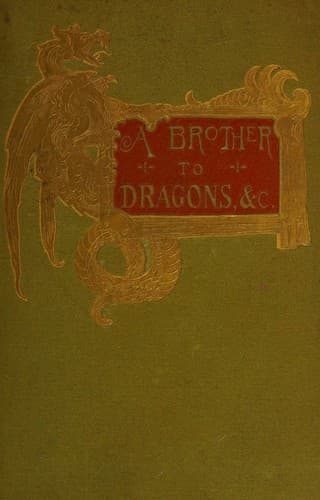
A brother to dragons, and other old-time talesRives, Amélie
Science
A brother to dragons, and other old-time tales
Rives, Amélie
American fiction -- 19th century
Well, th' months swung round, and 'twas nigh to Martlemas in that same
year, and one day as I sat i' th' forge door, a-swearing roundly to
myself concerning my lame arm, and how that 'twould not mend, up comes
galloping a man, like one distraught, and a child on th' saddle afore
him, and a flings himself down with th' child in 's arms (making no
shift whate'er to hold th' horse, which gallops on with th' reins
swinging), and a cries out, a-setting of th' child on my knee--a cries
out,
"For God's sake, help me! My child hath been bit by a mad dog! Help me
in some way, for th' love of God!"
And I saw that 'twas Robert Hacket that crouched and quivered at my knee
like a hurt hound, and th' child as like to him as one leaf on a tree is
to th' other. But ere I could do or say aught, comes that lass o' mine,
and ups with th' babe in her arms, and he roaring as lustily as any
bull-calf with th' wound in 's little brown arm, and she sees where the
beast hath bitten him. Then sets she him down again on my lap, and runs
and fetches a bar o' iron and heats it i' th' forge till 'tis white-hot,
and all th' time th' poor father a-sobbing, and kissing of th' babe, and
calling on me to help him, like as though I were God Almighty. And while
he was so doing, and the babe like to burst with weeping, and I gone mad
with not knowing what to be at, comes that wench, comrade, and jerks up
th' babe, and sets th' white-hot metal in 's soft flesh.
Ay, comrade, a did, and a held it there till where th' dog's fangs had
been was burned as black as th' anvil. And then, when 'tis done, and th'
babe again upon 's feet, and we two for praising and blessing o' her,
down drops she all in a heap on th' floor atween us, like a hawk that
hath been smitten in mid-heaven. Then 'twas, comrade, that th' babe was
left to endure his pain as best he might; never thought more did 's
father give him that day; but he runs and lifts th' lass in 's strong
arms, and bears her out into th' fresh air, and he calls her his
"dear," and his "own," and "his life," and his "Keren," till, had 't not
been for my lass's coming back to life, I would 'a' struck him on th'
mouth for a-speaking so unto her, and he th' husband o' another woman.
But no sooner opes she her eyes than he hath both her hands hid in one
o' his, and close against his breast, and she lying back in 's arms as
though she were any chrisom child, and her big eyes wide on his, and he
saith to her,
"Lass! lass!" saith he, "I ha' come to marry thee, an thou wilt have
me," quoth he. "I ha' come to marry thee; and may God bless thee for
saving th' child!"
Then did I understand; but she saith, with her great eyes not
moving--saith she--only one word--"Ruth?" saith she, even so, once, low
like that--"Ruth?"
"Ay, lass, I know," he saith unto her. "I know," he saith. "But all's
well with Ruth. Ruth is in heaven."
Public-domain text, read in full here on John Shaqi.
Reviews
Reviews
No reviews yet
Be the first to share your thoughts on this work.
Elsewhere in the archive
Join the Discussion
Join the discussion
Sign in to leave a comment or review.
Sign InorCreate an account