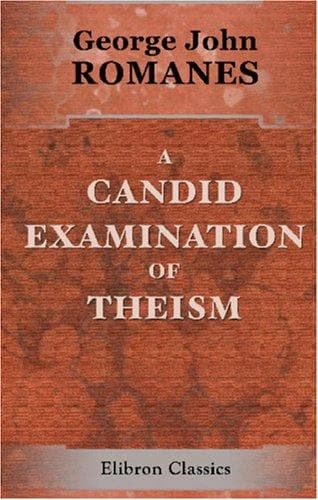
A Candid Examination of TheismRomanes, George John
Religion
A Candid Examination of Theism
Romanes, George John
Theism
I do not doubt that this way of looking at the subject will be deemed
unsatisfactory at first sight, because it seems to be, as it were, a merely
logical way of cheating our intelligence out of an intuitively felt
justification for its own curiosity in this matter. But the fault really
lies in this intuitive feeling of justification not being itself
justifiable. For this particular question, it will be observed, differs
from all other possible questions with which the mind has to deal. All
other questions being questions concerning manifestations of existence
presupposed as existing, it is perfectly legitimate to seek for an
explanation of one series of manifestations in another--_i.e._, to refer a
less known group to a group better known. But the case is manifestly quite
otherwise when, having merged one group of manifestations into another
group, and this into another for an indefinite number of stages, we
suddenly make a leap to the last possible stage and ask, "Into what group
are we to merge the basis of all our previous groups, and of all groups
which can possibly be formed in the future? How are we to classify that
which contains all possible classes? Where are we to look for an
explanation of Existence?" When thus clearly stated, the question, is, as I
have said, manifestly irrational; but the point with which I am now
concerned is this--When in plain reason the question is _seen_ to be
irrational, why in intuitive sentiment should it not be _felt_ to be so?
The answer, I think, is, that the interrogative faculty being usually
occupied with questions which admit of rational answers, we acquire a sort
of intellectual habit of presupposing every wherefore to have a therefore,
and thus, when eventually we arrive at the last of all possible wherefores,
which itself supplies the basis of all possible therefores, we fail at
first to recognise the exceptional character of our position. We fail at
first to perceive that, from the very nature of this particular case, our
wherefore is deprived of the rational meaning which it had in all the
previous cases, where the possibility of a corresponding therefore was
presupposed. And failing fully to perceive this truth, our organised habit
of expecting an answer to our question asserts itself, and we experience
the same sense of intellectual unrest in the presence of this wholly
meaningless and absurd question, as we experience in the presence of
questions significant and rational.
THE END.
* * * * *
Notes
Public-domain text, read in full here on John Shaqi.
Reviews
Reviews
No reviews yet
Be the first to share your thoughts on this work.
Elsewhere in the archive
Join the Discussion
Join the discussion
Sign in to leave a comment or review.
Sign InorCreate an account