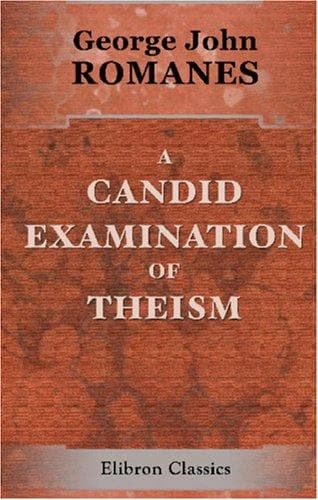
A Candid Examination of TheismRomanes, George John
Religion
A Candid Examination of Theism
Romanes, George John
Theism
Thus it is that scientific teleology in any form is now and for ever
obsolete. But not so with what I have termed metaphysical teleology. For as
we have seen that the doctrine of the relativity of knowledge precludes us
from asserting, or even from inferring, that beyond the region of the
Knowable Mind does not exist, it remains logically possible to institute a
metaphysical hypothesis that beyond this region of the Knowable Mind does
exist. There being a necessary absence of any positive information whereby
to refute this metaphysical hypothesis, any one who chooses to adopt it is
fully justified in doing so, provided only he remembers that the purely
metaphysical quality whereby the hypothesis is ensured against disproof,
likewise, and in the same degree, precludes it from the possibility of
proof. He must remember that it is no longer open to him to point to any
particular set of general laws and to assert, these proclaim Intelligence
as their cause; for we have repeatedly seen that the known states of matter
and force themselves afford sufficient explanation of the facts to which he
points. And he must remember that the only reason why his hypothesis does
not conflict with any of the truths known to science, is because he has
been careful to rest that hypothesis upon a basis of purely formal
considerations, which lie beyond even the most fundamental truths of which
science is cognisant.
Thus, for example, he may present his metaphysical theory of Theism in some
such terms as these:--'Fully conceding what reason shows must be conceded,
and there still remains this possible supposition--viz., that there is a
presiding Mind in nature, which exerts its causative influence beyond the
sphere of experience, thus rendering it impossible for us to obtain
scientific evidence of its action. For such a Mind, exerting such an
influence beyond experience, may direct affairs within experience by
methods conceivable or inconceivable to us--producing, possibly,
innumerable and highly varied results, which in turn may produce their
effects within experience, their introduction being then, of course, in the
ordinary way of natural law. For instance, there can be no question that by
the intelligent creation or dissipation of energy, all the phenomena of
cosmic evolution might have been directed, and, for aught that science can
show to the contrary, thus only rendered possible. Hence there is at least
one nameable way in which, even in accordance with observed facts, a
Supreme Mind could be competent to direct the phenomena of observable
nature. But we are not necessarily restricted to the limits of the nameable
in this matter, so that it is of no argumentative importance whether or not
this suggested method is the method which the supposed Mind actually
adopts, seeing that there may still be other possible methods, which,
nevertheless, we are unable to suggest.'
Public-domain text, read in full here on John Shaqi.
Reviews
Reviews
No reviews yet
Be the first to share your thoughts on this work.
Elsewhere in the archive
Join the Discussion
Join the discussion
Sign in to leave a comment or review.
Sign InorCreate an account