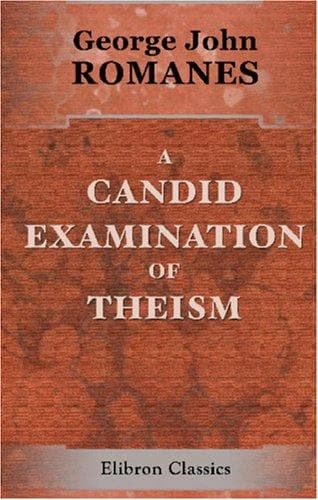
A Candid Examination of TheismRomanes, George John
Religion
A Candid Examination of Theism
Romanes, George John
Theism
in a super-scientific sphere, then in a super-scientific sphere it ought to
be posited. No doubt this hypothesis at first sight seems gratuitous,
seeing that, so far as science can penetrate, there is no need of any such
hypothesis at all--cosmic harmony resulting as a physically necessary
consequence from the combined action of natural laws, which in turn result
as a physically necessary consequence of the persistence of force and the
primary qualities of matter. But although it is thus indisputably true that
metaphysical teleology is wholly gratuitous if considered scientifically,
it may not be true that it is wholly gratuitous if considered
psychologically. In other words, if it is more conceivable that Mind should
be the ultimate cause of cosmic harmony than that the persistence of force
should be so, then it is not irrational to accept the more conceivable
hypothesis in preference to the less conceivable one, provided that the
choice is made with the diffidence which is required by the considerations
adduced in Chapter V.
I conclude, therefore, that the hypothesis of metaphysical teleology,
although in a physical sense gratuitous, may be in a psychological sense
legitimate. But as against the fundamental position on which alone this
argument can rest--viz., the position that the fundamental postulate of
Atheism is more _inconceivable_ than is the fundamental postulate of
Theism--we have seen two important objections to lie.
For, in the first place, the sense in which the word "inconceivable" is
here used is that of the impossibility of framing _realisable_ relations in
the thought; not that of the impossibility of framing _abstract_ relations
in thought. In the same sense, though in a lower degree, it is true that
the complexity of the human organisation and its functions is
inconceivable; but in this sense the word "inconceivable" has much less
weight in an argument than it has in its true sense. And, without waiting
again to dispute (as we did in the case of the speculative standing of
Materialism) how far even the genuine test of inconceivability ought to be
allowed to make against an inference which there is a body of scientific
evidence to substantiate, we went on to the second objection against this
fundamental position of metaphysical teleology. This objection, it will be
remembered, was, that it is as impossible to conceive of cosmic harmony as
an effect of Mind, as it is to conceive of it as an effect of mindless
evolution. The argument from inconceivability, therefore, admits of being
turned with quite as terrible an effect on Theism, as it can possibly be
made to exert on Atheism.
Public-domain text, read in full here on John Shaqi.
Reviews
Reviews
No reviews yet
Be the first to share your thoughts on this work.
Elsewhere in the archive
Join the Discussion
Join the discussion
Sign in to leave a comment or review.
Sign InorCreate an account