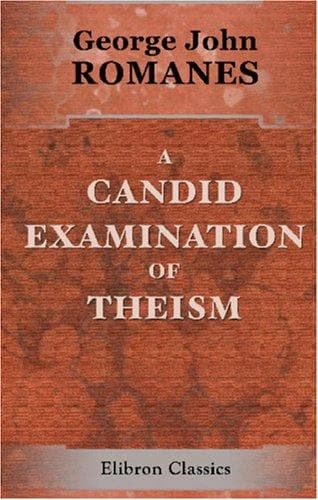
A Candid Examination of TheismRomanes, George John
Religion
A Candid Examination of Theism
Romanes, George John
Theism
part of each hypothesis, will scarce find his reason able to determine him
fixedly for or against the soul's materiality. Since on which side soever
he views it, either as an unextended substance or as a thinking extended
matter, the difficulty to conceive either will, whilst either alone is in
his thoughts, still drive him to the contrary side. An unfair way which
some men take with themselves, who, because of the inconceivableness of
something they find in one, throw themselves violently into the contrary
hypothesis, though altogether as unintelligible to an unbiassed
understanding."
This passage, I do not hesitate to say, is one of the most remarkable in
the whole range of philosophical literature, in respect of showing how even
the strongest and most candid intellect may have its reasoning faculty
impaired by the force of a preformed conviction. Here we have a mind of
unsurpassed penetration and candour, which has left us side by side two
parallel trains of reasoning. In the one, the object is to show that the
author's preformed conviction as to the being of a God is justifiable on
grounds of reason; in the other, the object is to show that, granting the
existence of a God, and it is not impossible that he may have endowed
matter with the faculty of thinking. Now, in the former train of reasoning,
the whole proof rests entirely upon the fact that "it is impossible to
conceive that ever bare incogitative matter should produce a thinking
intelligent being." Clearly, if this proposition is true, it must destroy
one or other of the trains of reasoning; for it is common to them both, and
in one of them it is made the sole ground for concluding that matter cannot
think, while in the other it is made compatible with the supposition that
matter may think. This extraordinary inconsistency no doubt arose from the
fact that the author was antecedently persuaded of the existence of an
_Omnipotent_ Mind, and having been long accustomed in his intellectual
symbols to regard it presumptuous in him to impose any limitations on this
almighty power, when he asked himself whether it would be possible for this
almighty power, if it so willed, to endow matter with the faculty of
thinking, he argued that it might be possible, notwithstanding his being
unable to conceive the possibility. But when he banished from his mind the
idea of this personal and almighty power, and with that idea banished all
its associations, he then felt that he had a right to argue more freely,
and forthwith made his conceptive faculty a test of abstract possibility.
Yet _the sum total of abstract possibility, in relation to him, must have
been the same in the two cases_; so that in whichever of the two trains of
reasoning his argument was sound, in the other it must certainly have been
null.
Public-domain text, read in full here on John Shaqi.
Reviews
Reviews
No reviews yet
Be the first to share your thoughts on this work.
Elsewhere in the archive
Join the Discussion
Join the discussion
Sign in to leave a comment or review.
Sign InorCreate an account