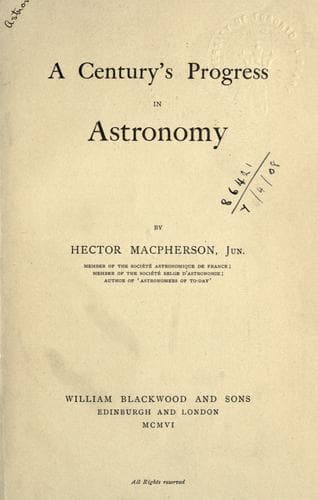
A Century's Progress in AstronomyMacpherson, Hector
History
A Century's Progress in Astronomy
Macpherson, Hector
Astronomy -- History
Various other astronomers have devoted themselves to the observation of
double stars, among them _Ercole Dembowski_ (1815-1881), of Milan; _Karl
Hermann Struve_ (born 1854), son of Otto Struve; _William Doberck_ (born
1845); _William J. Hussey_ (born 1864), now director of the Detroit
Observatory; Camille Flammarion; N. C. Dunér; G. V. Schiaparelli;
_Thomas Jefferson Jackson See_ (born 1866). But the greatest living
_discoverer_ is _Sherburne Wesley Burnham_ (born 1838), now employed at
the Yerkes Observatory, in Wisconsin. Born in 1838 at Thetford, Vermont,
he commenced his career as a shorthand reporter, studying astronomy in
his leisure hours. With a small 6-inch refractor, mounted in a home-made
observatory, Burnham commenced in 1871 his discoveries of double stars,
which soon attracted the attention of noted astronomers, who permitted
him to use larger telescopes, with which he continued his researches.
His first official appointment was in 1888, when he became chief
assistant at the Lick Observatory, which position he resigned in 1892.
Some years later he became astronomer in the Yerkes Observatory.
Altogether he has discovered 1308 double stars, with telescopes ranging
from a 6-inch refractor to the gigantic 40-inch of the Yerkes
Observatory.
The computation of double-star orbits has been undertaken by various
astronomers, among them Mädler, Klinkerfues, Dunér, Flammarion,
Seeliger, See, Gore, Burnham, _Robert Grant Aitken_ (born 1864) of the
Lick Observatory, and _Giovanni Celoria_ (born 1842), who was, from 1866
to 1900, assistant in the Brera Observatory of Milan, and since 1900
director of that institution. On June 9, 1890, Gore presented to the
Royal Irish Academy a catalogue of computed binaries containing
reference to fifty-nine stars.
In 1844 Bessel discovered a remarkable irregularity in the proper motion
of Sirius. He ascribed this to the gravitational influence of some
obscure body, probably a large satellite. In 1857 Peters calculated an
orbit for the supposed satellite with a period of 50 years. In 1861 an
orbit was computed by _Truman Henry Safford_ (1836-1901), which
indicated the position of the satellite. Close to this position it was
accidentally discovered by _Alvan Clark_ (1832-1897), the famous
American optician. The period of the star seems to be about 50 years. In
1844 Bessel noticed irregularities in the proper motion of Procyon, and
put forward the idea of a disturbing satellite, as in the case of
Sirius. This was confirmed by Mädler, and in 1874 an orbit was computed
by Auwers, who found a period of 40 years. In 1896 the satellite was
found by Schaeberle with the 36-inch refractor of the Lick Observatory.
A period of 40 years was found by See, in agreement with the
hypothetical orbit.
Public-domain text, read in full here on John Shaqi.
Reviews
Reviews
No reviews yet
Be the first to share your thoughts on this work.
Elsewhere in the archive
Join the Discussion
Join the discussion
Sign in to leave a comment or review.
Sign InorCreate an account