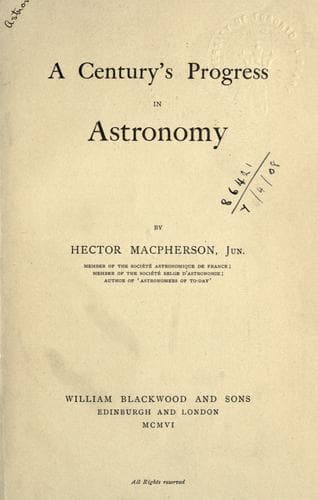
A Century's Progress in AstronomyMacpherson, Hector
History
A Century's Progress in Astronomy
Macpherson, Hector
Astronomy -- History
In 1825 the comet was again observed by Valz, passing perihelion on
September 16, and in 1828 it was seen by Struve. Encke now made a very
remarkable discovery. Determining its period with great accuracy, in
1832 he found that his comet returned to perihelion two and a half hours
before the predicted time. As this repeatedly happened, Encke put
forward the theory that the acceleration was due to the existence of a
resisting medium in the neighbourhood of the Sun, too rarefied to retard
the planetary motions, but quite dense enough to make the comet’s path
smaller, and to eventually precipitate it on the Sun. The theory was
widely accepted, but after 1868 the acceleration began to decrease,
diminishing by one-half; besides, no other comet is thus accelerated,
and the hypothesis has accordingly been abandoned.
The second comet recognised as periodic was that discovered on February
27, 1826, by an Austrian officer, _Wilhelm von Biela_ (1782-1856), and
ten days later by the French observer, _Gambart_ (1800-1836), both of
whom, in computing its orbit, noticed a remarkable similarity to the
orbits of comets which appeared in 1772 and 1805. Accordingly, they
concluded it to be periodic, with a period of between six and seven
years. The comet returned in 1832. In 1828 Olbers had published certain
calculations showing that portions of the comet would sweep over the
part of the Earth’s orbit a month later than the Earth itself. This gave
rise to a panic that the comet would destroy the Earth, which did not
subside till it was announced by Arago that the Earth and the comet
would at no time approach to within fifty million miles of each other.
The comet returned again in the end of 1845. It was kept well in view by
astronomers in Europe and America. On December 19, 1846, Hind noticed
that the comet was pear-shaped, and ten days later it had divided in
two. The two comets returned again in 1852 and were well observed; but
they were never seen again, at least as comets. Their subsequent history
belongs to meteoric astronomy.
A comet discovered by Faye at Paris in 1843 was found to have a period
of seven and a half years. It has returned regularly since its
discovery, true to astronomical prediction. Its motion was particularly
investigated for traces of a resisting medium, by _Didrik Magnus Axel
Möller_ (1830-1896), director of the Lund Observatory, who reached a
negative conclusion.
Public-domain text, read in full here on John Shaqi.
Reviews
Reviews
No reviews yet
Be the first to share your thoughts on this work.
Elsewhere in the archive
Join the Discussion
Join the discussion
Sign in to leave a comment or review.
Sign InorCreate an account