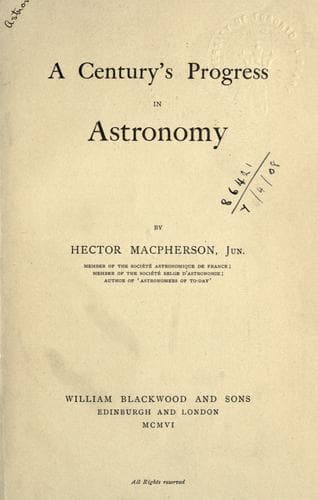
A Century's Progress in AstronomyMacpherson, Hector
History
A Century's Progress in Astronomy
Macpherson, Hector
Astronomy -- History
In 1835 Halley’s comet returned to perihelion, and was attentively
studied by the most famous astronomers of the age. It was particularly
studied by Sir John Herschel and by Bessel, who assisted in developing
Olbers’ theory of electrical repulsion. But the most brilliant comet of
the century was that which suddenly appeared on February 28, 1843, in
the vicinity of the Sun. This great comet, whose centre approached the
Sun within 78,000 miles, rushed past its perihelion at the speed of 366
miles a second. The comet’s tail reached the length of 200 millions of
miles. The comet of 1843 was however outshone, not in brilliance but as
a celestial spectacle, by the great comet discovered on June 2, 1858, by
_Giovanni Battista Donati_ (1826-1873) at Florence, and since known by
his name. It became visible to the naked eye on August 19, and was
telescopically observed until March 4, 1859. There was abundance of
time, therefore, to study the comet, which was exhaustively observed by
G. P. Bond at Harvard. His observations convinced him that the light
from Donati’s comet was merely reflected sunshine, and this was
generally accepted. Another great comet appeared in 1861. Like that of
1843, its appearance was sudden, being observed after sunset on June 30,
1861, when, says Miss Clerke, “a golden yellow planetary disc, wrapt in
dense nebulosity, shone out while the June twilight in these latitudes
was still in its first strength.” On the same evening the Earth and the
Moon passed through the tail of the great comet. The vast majority of
people never knew that such a phenomenon had taken place, and even the
astronomers only noticed a singular phosphorescence in the sky—a proof
of the extreme tenuity of comets.
The first application of the spectroscope to the light of comets was
made by Donati in 1864. The spectrum was found to consist of three
bright bands, but Donati was unable to identify them. However, his
observation gave the death-blow to the theory that comets shone by
reflected light alone, for it implied the existence of glowing gas in
them. On the appearance in 1868 of the periodic comet discovered by
_Friedrich August Theodor Winnecke_ (1835-1897), the spectrum was
examined by Huggins, who identified the bright bands with the spectrum
of hydrocarbon. This was confirmed in regard to Coggia’s comet of 1874
by Huggins himself, and also Brédikhine and Vogel. The hydrocarbon
spectrum is characteristic of comets, and has been recognised in all
those spectroscopically studied.
Public-domain text, read in full here on John Shaqi.
Reviews
Reviews
No reviews yet
Be the first to share your thoughts on this work.
Elsewhere in the archive
Join the Discussion
Join the discussion
Sign in to leave a comment or review.
Sign InorCreate an account