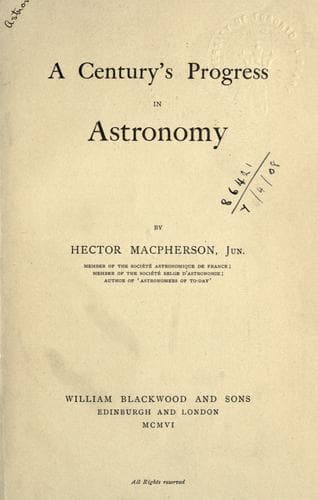
A Century's Progress in AstronomyMacpherson, Hector
History
A Century's Progress in Astronomy
Macpherson, Hector
Astronomy -- History
Closely allied to this subject is the existence of “comet families,”
demonstrated by Hoek of Utrecht in 1865, and mentioned in our chapter on
the Outer Planets. These comets are found to be dependent on the
planets, Jupiter, Saturn, Uranus, and Neptune, each possessing a
comet-group. Various theories have been advanced to account for the
existence of these groups. One of these theories is that the comets have
been captured by the various planets, who have forced them into their
present orbits. A mathematical study by _Jean Pierre Octave Callandrean_
(1852-1904) shows that the large number of comets possessed by the
various planets may be explained by the disintegration of large comets
into small ones. The capture theory, it must be remembered, is purely
hypothetical, and must not be regarded as anything but a theory. All
that we really know is the existence of comet-families, and of comets
moving in the same orbits.
The first photograph of a comet was that of Donati’s, taken in 1858 by
Bond. In 1881 Tebbutt’s comet was photographed in England by Huggins,
and in America by _Henry Draper_ (1837-1882), while in 1882 Gill secured
excellent photographs of the great September comet. The first
photographic discovery of a comet was made by Barnard in 1892. Since
then photography has been much used in cometary astronomy. No bright
comets have appeared since 1882,—if we except the comet of 1901, only
seen in the southern hemisphere,—although several have been just visible
to the naked eye, among them Swift’s comet of 1892 and Perrine’s in the
autumn of 1902. Telescopic comets, however, are very numerous, and a
year never passes without one or more being discovered. The ordinary
periodic comets, such as Encke’s, Faye’s, and others, are very faint,
and are becoming fainter at each return—a clear proof that comets die,
as Kepler said three centuries ago. This brings us to the subject of the
next chapter, Meteoric Astronomy.
CHAPTER VIII.
METEORS.
There is no more interesting chapter in the history of astronomy than
that relating to meteors. A hundred years ago shooting-stars were not
considered to be astronomical phenomena. They were supposed to be merely
inflammable vapours which caught fire in the upper regions of our
atmosphere, although both Halley and the scientist _Ernst Chladni_
(1756-1827) had notions of their celestial origin. For thirty-three
years after the beginning of the century, however, nothing was heard of
meteoric astronomy, nor was the subject considered as part of the
astronomer’s labours.
Public-domain text, read in full here on John Shaqi.
Reviews
Reviews
No reviews yet
Be the first to share your thoughts on this work.
Elsewhere in the archive
Join the Discussion
Join the discussion
Sign in to leave a comment or review.
Sign InorCreate an account