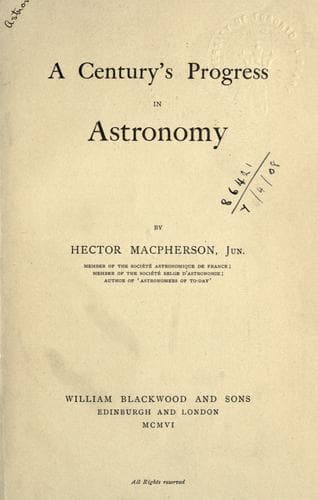
A Century's Progress in AstronomyMacpherson, Hector
History
A Century's Progress in Astronomy
Macpherson, Hector
Astronomy -- History
Pickering proposed in 1880 the following classification of variable
stars, which has been adopted all over the scientific world: Class I.,
temporary star; Class II., stars undergoing in several months large
variations, such as Mira Ceti and U Orionis; Class III., irregular
variables, such as Betelgeux and α Herculis; Class IV., short-period
variables, such as δ Cephei, ζ Geminorum, and β Lyræ; Class V., “Algol
variables,” which undergo variations lasting but a few hours. It is
doubtful whether new stars should be included in a classification of
variables, although in one case, at least, a new star was found to be a
long-period variable. To these a sixth class may now be added. This
class, the detection of which is mainly due to the profound
investigations of Gore, is composed of what have been termed “secular
variables,” which undergo slow fluctuations in periods of many years,
and sometimes of centuries. This Class includes δ Ursæ Majoris, Al-Fard,
λ Draconis, θ Serpentis, ε Pegasi, 83 Ursæ Majoris, ζ Piscis Australis,
β Leonis, α Ophiuchi, η Crateris, and others. The secular variations of
some of these stars have been detected by Gore himself during the past
thirty years, while in other cases he has detected them by comparison of
the most important star-catalogues, from Hipparchus and Al-Sufi down to
our own time. In some cases the star in question seems to be slowly
gaining in brilliance, in others slowly diminishing.
Thanks to the application of the spectroscope, much is now known of the
cause of the light changes in variable stars. Goodricke’s theory of the
variations of Algol was theoretically confirmed by the researches of E.
C. Pickering in 1880. In 1889 Vogel proved beyond a doubt that the
variation in the light of Algol is due to the partial eclipse of its
light by a dark satellite. It was obvious to Vogel that, as both Algol
and its companion are in revolution round their common centre of
gravity, the motion of Algol in the line of sight might be detected by
the spectroscopic method of observation. Vogel found that before each
eclipse Algol was retreating from our system, while on recovering it
gave signs of rapid approach, proving conclusively that both the star
and its dark satellite were in revolution round their centre of
gravity,—Algol suffering partial eclipse only because the plane of the
orbit lies in our line of sight. Algol, therefore, is not inherently a
variable star, but merely a binary. Following up his researches, Vogel,
assuming that the bright and dark stars are of equal density, arrived at
the conclusion that Algol is a globe about one and a half million miles
in diameter, the satellite equalling the size of the Sun, and the
centres of the stars being separated by about 3,230,000 miles. Thus,
variable stars of the Algol type are not variable in the true sense of
the word. Even the most irregular of the Algol variables have been
explained. Perhaps the most irregular was Y Cygni, discovered by
Chandler in 1886.
Public-domain text, read in full here on John Shaqi.
Reviews
Reviews
No reviews yet
Be the first to share your thoughts on this work.
Elsewhere in the archive
Join the Discussion
Join the discussion
Sign in to leave a comment or review.
Sign InorCreate an account