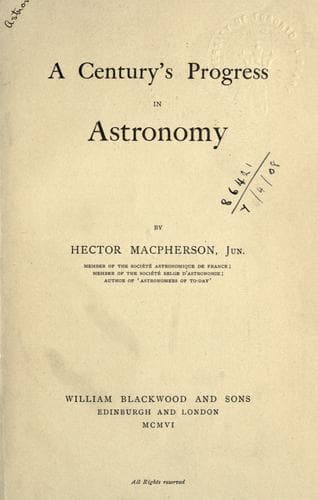
A Century's Progress in AstronomyMacpherson, Hector
History
A Century's Progress in Astronomy
Macpherson, Hector
Astronomy -- History
John Herschel did not turn his attention to astronomy until he had
attained the age of twenty-four. In a letter to a friend, September 10,
1816, he said, “I am going, under my father’s directions, to take up
star-gazing.” It was only reverence for his father that made him turn to
astronomy, and he gave up the science he loved most—chemistry. But his
unselfishness received its reward. In 1820 John Herschel constructed his
first reflector under his father’s guidance. Four years previously he
had begun to observe double stars, which had been for long studied by
his father, who discovered their revolutions. These observations were
continued from 1821 to 1823 at the Observatory of Sir _James South_
(1786-1867). John Herschel and South measured 380 of the elder
Herschel’s double stars. These investigations gained for Herschel and
South the Lalande Prize of the French Academy and the Gold Medal of the
Royal Astronomical Society.
When his mother died Sir John Herschel decided to sail to the Cape of
Good Hope to make an investigation of the stars of the southern
hemisphere, which until then had been much neglected. He was offered a
free passage in a ship of war, but declined. In November 1833 he left
England, taking with him his great telescopes. In two months he arrived
at Cape Town, and erected his astronomical instruments at Feldhausen, a
short distance off. In October 1835 he informed his aunt that he had
almost completed his survey of the southern hemisphere. During his
“sweeps” of the heavens he discovered 1202 double stars, and 1708 nebulæ
and star-clusters. In 1838 he returned to England, and devoted the
remainder of his life to the publication of his results, as well as to
other branches of science. He died at Collingwood, in Kent, on May 11,
1871, at the age of seventy-nine.
Public-domain text, read in full here on John Shaqi.
Reviews
Reviews
No reviews yet
Be the first to share your thoughts on this work.
Elsewhere in the archive
Join the Discussion
Join the discussion
Sign in to leave a comment or review.
Sign InorCreate an account