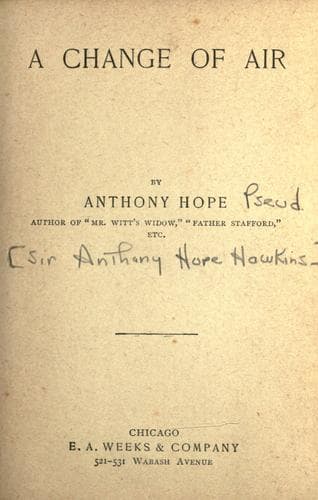
Country homes -- Fiction; England -- Social life and customs -- 19th century -- Fiction; Fame -- Fiction; Poets -- Fiction
Philip Hume sat alone under a spreading tree, looking on, and talking
to nobody. The bustle of the morning, and the sumptuous midday meal
worked together with the warm afternoon air and the distant sounds
of the yeomanry band to make him a little drowsy, and he watched the
people walking to and fro, and heard their chatter in a half-wakeful,
half-sleeping state. And, strange as it seems in this workaday,
skeptical age, he fell into a sort of trance, and visions of what
should be were vouchsafed to him, and if the visions were not true, at
least they had a look of truth.
He saw a man, handsome still, for all that his thick hair was a little
thinned by time and his waistcoat was broadening, and the man read in
a mellow voice lines, which Philip did not hear very plainly, about
the greatness of England, the glory of the Throne, and the calmer
judgment of circling years tempering the heat of youth. Then a stately
dame touched him gently on the shoulder, saying that the verses were
magnificent, but the carriage waited to take him to the _levée_; and
he rose to go with a smile, not seeming to notice a pale ghost, that
clenched impotent shadowy hands in wrath and with a scowl shrank away.
Suddenly, across this vision came the form of Mrs. Hodge, white-haired,
but cheerful and buxom as of yore, and she said: "Well, Hume, she's
made Arthur a happy man at last;" and the Mayor, who somehow happened
to be there, wearing on his breast a large placard, inscribed "Sir
James Hedger, Knight," added, quite in his old way: "We were all wrong,
Mr. Hume, sir, except you, sir, beggin' your pardon." Then the Squire's
voice broke in, as though in the course of an argument, and declared
that it was nonsense to attribute Dale's change of views to anything
except growing wisdom; and the phantom of Colonel Smith, a copy of
"The Clarion" in his hand, answered: "Bosh!" And a crowd of quite
indistinguishable, well-dressed shades gathered round the Colonel, and
Philip heard them talking about the inevitable gravitation of culture
and intelligence. But the Colonel still answered "Bosh!" and Philip
did not hear the end of the matter, nor where the truth of it lay; for
presently all the forms passed away, and he saw a little room, a little
dingy room, and a gray-haired, slouching fellow in an old coat, smoking
an old pipe and scribbling on foolscap, scribbling away far into the
night, and then sitting and musing for a solitary half hour in front
of his dying fire before he went to bed. There was something in this
figure that made Philip curious, and he went nearer and looked. Hush!
It was himself, and----
He awoke with a start. Dale was smiling down on him with his old
friendly smile, and saying to Janet Delane:
"We shall never let this old chap leave us for long, shall we, Jan?"
THE END.
_Twelfth Edition._
THE PRISONER OF ZENDA.
By ANTHONY HOPE.
16mo, buckram, gilt top, with frontispiece, 75 cents.
Public-domain text, read in full here on John Shaqi.
Reviews
Reviews
No reviews yet
Be the first to share your thoughts on this work.
Elsewhere in the archive
Join the Discussion
Join the discussion
Sign in to leave a comment or review.
Sign InorCreate an account