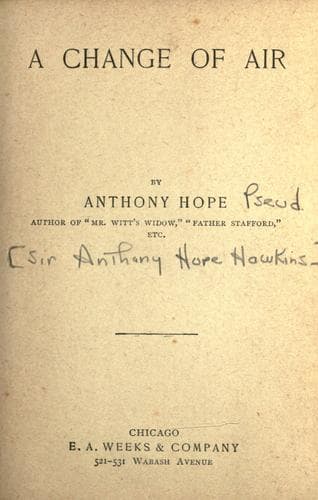
Country homes -- Fiction; England -- Social life and customs -- 19th century -- Fiction; Fame -- Fiction; Poets -- Fiction
_Twelfth Street Meeting_ and _Uncle Joseph_ both treat of the bashful
Quaker in love, with a quiet humor and an effective but unobtrusive
description of Quaker customs. The _Two Gentlewomen_ were once Friends;
but one of them having become the widow of a fast young Englishman,
they both take up the ways of the mother country. A courtly old colonel
courts them both with rare impartiality. _Our Little Neighbors_ is a
sympathetic picture of childhood, with a quaintly humorous ending.
Even more humorous is _Pamelia Tewksbury's Courtship_, laid in central
New York. Mrs. Gardner's treatment of this episode, though it recalls
Miss Wilkins, can well bear the comparison. Next come the _Ante-Bellum
Letters_, which occupy about a third of the book and make an excellent
foil to the more demure tales which they interrupt like a sort of
vigorous interlude. The Quakeress who writes them is suddenly plunged
into the comparative dissipations of Boston, into the lively society of
Harvard undergraduates, and into gay raiment that distresses her; but
this lively intermezzo ends with a graver strain. The figures of the
great Abolitionists are faintly seen, and at the trial of a poor negro
boy, who is demanded as a fugitive slave, Lucretia Mott appears and
sits by the prisoner, cheering him through the long night session of
the court. The frontispiece represents this scene. The book closes with
a quaint old story, way back in 1815, in which a romantic French boy,
escaped from jail, and a Quakeress, more beautiful than her parents
care to have her, figure prominently. There is a deep note of pathos in
this tale, and the good influence of the Quakers in prison reform is
shown, as their brave work for abolition has been in the _Ante-Bellum
Letters_. Here and there a few lines give remarkable nature-pictures,
as in the following:
"The midsummer heat was upon the land. The red sun set in splendor, and
the blood-red moon rose as in wrath."
Jerome's John Ingerfield;
=The Woman of the Saeter, Silhouettes, Variety Patter=, and =The Lease
of the Cross-keys=. The title-story (half the book) and the two that
follow are in serious vein. With portrait of Jerome and illustrations.
Small 16mo. 75 cents.
"This dainty little volume, contrived to look like a tall folio in
miniature ... the creepy Norwegian ghost story (_The Woman of the
Saeter_) ... the vague but picturesque sketch called _Silhouettes_....
The first (_John Ingerfield_) is a very sweet and pathetic love story
... true to the best there is in human nature ... many diverse traits
of character and striking incidents being compressed within its
narrow limits.... It is a good thing to write an honest, wholesome,
old-fashioned love story like _John Ingerfield_."--_New York Times._
"Rare combination of true pathos and thoroughly modern humor."--_The
Churchman._
Public-domain text, read in full here on John Shaqi.
Reviews
Reviews
No reviews yet
Be the first to share your thoughts on this work.
Elsewhere in the archive
Join the Discussion
Join the discussion
Sign in to leave a comment or review.
Sign InorCreate an account