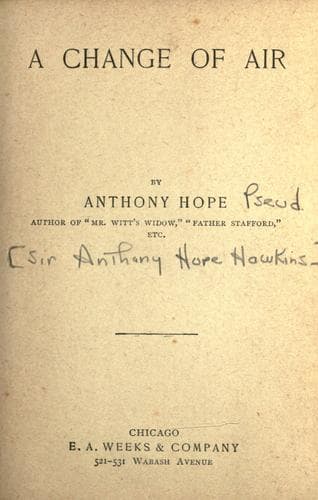
Country homes -- Fiction; England -- Social life and customs -- 19th century -- Fiction; Fame -- Fiction; Poets -- Fiction
"Is he staying to-night?"
"Yes; two or three days, I think."
"Well, dear, I am glad we amuse him. There doesn't seem much for a man
to do here, does there?"
"Don't you like him to be here?"
"Oh, I don't mind; only he wastes my time."
"I begin to think he's wasting his own too," remarked Mrs. Delane.
"Oh, he's got nothing else to do with it--or at least he does nothing
else with it."
"You know what I mean, Janet, dear."
"I suppose I do, but how can I help it? I do all I can to show him it's
no use."
"You used to like him very much."
"Oh, so I do now. But that's quite different."
The world goes very crooked. Mrs. Delane sighed again.
"It would have pleased your father very much."
"I'm so sorry. But I couldn't care for a man of that sort."
"What's the matter with the man, my dear?"
"That's just it, mamma. Nothing--nothing bad--and nothing good. Gerard
is like heaps of men I know."
"I think you underrate him. His father was just the same, and he was
very distinguished in the House."
Janet's gesture betrayed but slight veneration for the High Court of
Parliament, as she answered: "They always say that about dull people."
"Well, if it's no use, the sooner the poor boy knows it the better."
"I can't tell him till he asks me, can I, dear? Though I'm sure he
might see it for himself."
Mrs. Delane, when she made up her mind to sound her daughter's
inclinations, had expected to find doubt, indecision, perhaps even
an absence of any positive inclination toward Captain Ripley. She
had not been prepared for Janet's unquestioning assumption that
the thing was not within the range of consideration. A marriage so
excellent from a material point of view, with one who enjoyed all the
advantages old intimacy and liking could give, seemed to claim more
than the unhesitating dismissal with which Janet relegated it to the
limbo of impossibility, with never a thought for all the prospects
it held out, and never a sigh for the wealth and rank it promised. Of
course the Delanes needed no alliances to establish their position;
still, as the Squire had no son, it would have been pleasant if his
daughter had chosen a husband from the leading family in the county.
The more Mrs. Delane thought, the more convinced she became that there
must be a reason; and if there were, it could be looked for only in
one direction. She wondered whether the Squire's _penchant_ for his
gifted young neighbor was strong enough to make him welcome him as a
son-in-law. Frankly, her own was not.
Mr. Delane came in to luncheon, but Captain Ripley sent a message of
excuse. He had ridden over to Sir Harry Fulmer's, and would spend
the afternoon there. Mrs. Delane's reception of the news conveyed
delicately that such conduct was only what might be expected, if one
considered how Janet treated the poor fellow, but the Squire was too
busy to appreciate the subtleties of his wife's demeanor.
Public-domain text, read in full here on John Shaqi.
Reviews
Reviews
No reviews yet
Be the first to share your thoughts on this work.
Elsewhere in the archive
Join the Discussion
Join the discussion
Sign in to leave a comment or review.
Sign InorCreate an account