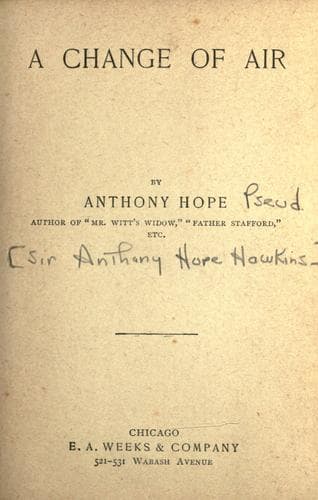
Country homes -- Fiction; England -- Social life and customs -- 19th century -- Fiction; Fame -- Fiction; Poets -- Fiction
The Alderman's attitude, on receiving this offer, was not without
pathos. He lamented in himself an obstinate rectitude, which he
declared had often stood in his way in business affairs. His political
convictions, engaged as they were in the matter, he would have
sacrificed, if the favor thereby accorded to Mr. Bannister were so
great as to be measured by two hundred pounds; but he had passed his
word; and he concluded by beseeching Dale not to tempt him above that
which he was able.
"Take it away, take it away, sir," he said when Dale held a pocketbook
before his longing eyes. "It aint right, sir, it aint indeed--and me a
family man."
Dale began to feel the guilt of the Tempter, and fell back on an appeal
to the Alderman's better feelings. This line of argument elicited only
a smile.
"If I won't do it for two hundred sovereigns, does it stand to reason,
sir, as I should do it to obleege?"
Dale left him, after a plain statement of the estimation in which he
held him, and went home, yielding, only after a struggle, to Philip's
representation that any attempt to bribe the sandwich-men must result
in his own greater humiliation and discomfiture.
Angry as Dale was, he determined not to allow this incident to turn
him from the course he had marked out for himself. It confirmed his
determination to have nothing to do with Sir Harry's Radical song, but
it did not make him any the more inclined to appear as a eulogist of
royalty. Neutrality in all political matters was his chosen course,
and it appeared to him to be incomparably the wisest under all the
circumstances. This view he expressed to the family at the Grange,
having walked over for that purpose. He expected to meet with some
opposition, but to his surprise the Squire heartily acquiesced.
"After this scandalous business," he said, "you must cut the Radicals
altogether. Of course, Harry Fulmer will object to it as much as we do,
but he must be responsible for his followers. And I think you're quite
right to let us alone, too. Why should you literary men bother with
politics?"
Dale was delighted at this opinion, and at Janet's concurrence with it.
"Then I dare say you will be so kind as to express my feelings to Lord
Cransford; if he thinks fit, he can let the Duke know them."
The Squire's face expressed surprise, and his daughter's reflected it.
"But, my dear fellow," said Mr. Delane, "what has Cransford's
suggestion to do with politics? The throne is above politics."
"Surely, Mr. Bannister," added Janet, "we are all loyal, whatever our
politics? I'm sure Sir Harry himself is as loyal as papa."
"Come, Bannister, you press your scruples too far. There are no
politics in this."
Dale was staggered, but not convinced.
"I'd rather not put myself forward at all," he said.
The Squire assumed an air of apologetic friendliness.
Public-domain text, read in full here on John Shaqi.
Reviews
Reviews
No reviews yet
Be the first to share your thoughts on this work.
Elsewhere in the archive
Join the Discussion
Join the discussion
Sign in to leave a comment or review.
Sign InorCreate an account