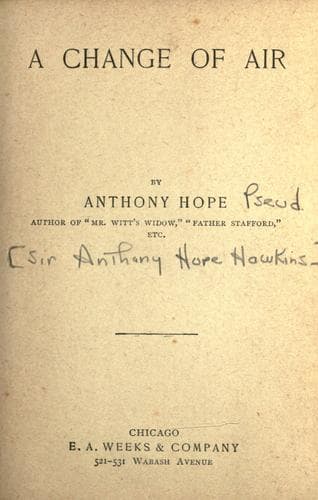
Country homes -- Fiction; England -- Social life and customs -- 19th century -- Fiction; Fame -- Fiction; Poets -- Fiction
"The moving Finger writes, and having writ
Moves on, nor all your piety nor wit
Can lure it back to cancel half a line,
Nor all your tears wash out a word of it."
"And yet," said Philip, stretching out a hand to the flickering blaze,
"we go on being pious and wise--some of us; and we go on crying--all of
us."
CHAPTER XVIII.
=Delilah Johnstone.=
When it became known to Mr. Delane that the ode of welcome would
be forthcoming,--a fact which, without being definitely announced,
presently made its way into general knowledge,--he felt that he owed
Dale Bannister a good turn. The young man was obviously annoyed and
hurt at the aspect of Alderman Johnstone's window, and the Squire could
not, moreover, conceal from himself that the parade of the Alderman's
sandwich-men on the day of the royal visit would detract from the
unanimity of loyalty and contentment with Queen and Constitution which
he felt Denborough ought to display. Finally, his wife and his daughter
were so strongly of opinion that something must be done that he had
no alternative but to try to do something. Intimidation had failed;
the Alderman intrenched himself behind his lease; and Colonel Smith's
open triumph was hardly needed to show the Squire that in this matter
he had been caught napping. Bribery of a direct and pecuniary sort was
apparently also of no avail, and the Squire was driven to play his last
card at the cost of great violence to his own feelings. A week before
the great day he sent for the Mayor and was closeted with him for half
an hour. The Mayor came out from the conference with an important air,
and, on his way home, stopped at Alderman Johnstone's door. The poems,
placards, and posters were still prominently displayed, and over the
way James Roberts, in his well-worn coat, paced up and down on his
unwearying patrol. He would wait days rather than miss Dale, in case
the poet might chance to pass that way. He had nothing to do, for no
one sent for him now; he had no money, and could earn none; therefore
his time was his own, and he chose to spend it thus, forgetting his
wife and his child, forgetting even to ask how it happened that there
was still food and fuel in his house, or to suspect what made him so
often see Philip Hume walk past with an inquiring gaze, indifferently
concealed, and so often meet Dale's servant, Wilson, carrying baskets
up and down the street on his way to and from Littlehill.
The Mayor went in and fell into conversation with Johnstone. He spoke
of the glories of the coming day, of his own new gown, and of Mrs.
Hedger's; and as he raised his voice in enthusiastic description Mrs.
Johnstone stole in from the back parlor and stood within the door. The
Alderman affected scorn of the whole affair, and chuckled maliciously
when the Mayor referred to Dale Bannister.
Public-domain text, read in full here on John Shaqi.
Reviews
Reviews
No reviews yet
Be the first to share your thoughts on this work.
Elsewhere in the archive
Join the Discussion
Join the discussion
Sign in to leave a comment or review.
Sign InorCreate an account