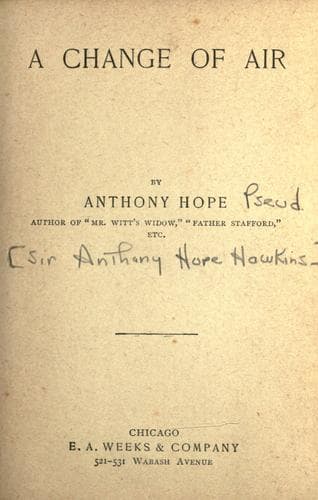
Country homes -- Fiction; England -- Social life and customs -- 19th century -- Fiction; Fame -- Fiction; Poets -- Fiction
"Well, there must be some ordinary people," protested Philip. "The
_rôle_ is unappreciated, so it's the more creditable in me to stick to
it."
"A parcel of nonsense! Where's that paper?"
She took it, went upstairs, and gave it to Nellie.
"There, read that. See what they say about you, my dearie. I'm going to
see little Roberts, and I shall be back in an hour. You've got the bell
by you, and the nurse'll hear you."
Nellie, left alone, began to read the _Chronicle_. She read the whole
account from beginning to end, the article in praise of her, and, in
the later edition, the editor's romantic forecast. Then she put the
papers aside, exclaiming: "Oh, if it could be true!" and lay back with
closed eyes.
A few days later she made her first appearance in the drawing room,
where she held a little court. Her mother hung over all, anticipating
far more wants than the patient was likely to feel, and by constant
anxious questions almost producing the fatigue she wished to guard
against. Tora Smith was there, in a state of gleeful adoration; and
Arthur Angell, his sorrows temporarily laid aside, ready with a mock
heroic ode; and Philip Hume, new come from Mrs. Roberts' with good news
and a high eulogy on Dr. Spink's most marked and assiduous attention.
"I really believe," he said, with a laugh, "that Mrs. Roberts will have
another chance of being a Denborough doctor's wife, if she likes."
"That would be an ideal ending," said Tora.
"Therefore it will not happen," Arthur remarked.
"Poets are allowed to be pessimistic," rejoined Tora. "But you're
wrong, Mr. Angell. Ideal things do happen."
"To Sir Harry Fulmer, for instance," put in Philip.
"Nonsense, Mr. Hume! I wasn't thinking of that. Don't you agree with
me, Nellie?"
"Nellie has made an ideal thing happen," said Philip, and Nellie
blushed.
"Thanks, Phil," said Dale. "It's complimentary to describe the
prolongation of my poor existence in that way."
"The deed is good, however unworthy the object, Dale."
Dale took Nellie's hand and patted it gently.
"Good child," he said, and Nellie flushed again with an almost strange
intensity of embarrassment. Tora rose abruptly, and, in spite of
opposition, insisted on departure. Dale escorted her to her carriage.
"I have asked Nellie to come and stay with me," said she, "as soon as
she is well enough to move."
"She will like that. I hope she is going?"
"She said," Tora went on, speaking with emphasis, "that she would ask
you."
Dale made a little gesture of protest, partly against Nellie's reported
saying, more against the reporter's inquiring gaze. He began to be
astonished at the interest he was so unfortunate as to inspire in his
affairs.
"I shall advise her to go," he said. "I think a change will be good for
her."
"I incline to think so too," said Tora with sudden coldness; "but I
thought you might not like to part with her."
Public-domain text, read in full here on John Shaqi.
Reviews
Reviews
No reviews yet
Be the first to share your thoughts on this work.
Elsewhere in the archive
Join the Discussion
Join the discussion
Sign in to leave a comment or review.
Sign InorCreate an account