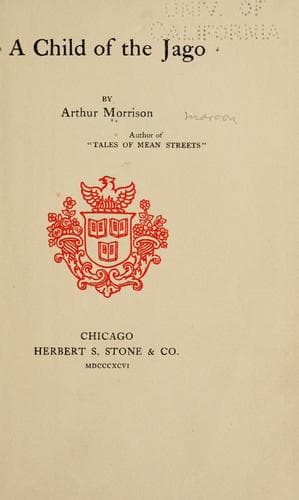
Boys -- Fiction; London (England) -- Fiction; Slums -- Fiction
In the Perrott case, indeed, the sufferers were fortunate, as things
went. Mrs Perrott had but herself and the child of two to keep, for
Dicky could do something, whether good or bad, for himself. The vicar
might try to get regular work for Dicky, but it would be a vain toil,
for he must tell an employer what he knew of Dicky's past and of that
other situation. He could but give the woman the best counsel at his
command, and do what he might to quicken any latent spark of energy. So
he did his best, and that was all. The struggle lay with Hannah Perrott.
She had been left before, and more than once; but then the periods had
been shorter, and, as a matter of fact, things had fallen out so well
that scarce more than a meal here and there had had to be missed,
though, when they came, the meals were apt to be but of crusts. And now
there was more trouble ahead; for though she began her lonely time with
but one small child on hand, she knew that ere long there would be two.
Of course, she had worked before; not only when Josh had been 'in' but
at other times, to add to the family resources. She was a clumsy
needlewoman: else she might hope to earn some ninepence or a shilling a
day at making shirts, by keeping well to the needle for sixteen hours
out of the twenty-four; and from the whole sum there would be no
deductions, except for needles and cotton, and what the frugal employer
might choose to subtract for work to which he could devise an objection.
But, as it was, she must do her best to get some sack-making. They paid
one and sevenpence a hundred for sacks, and, with speed and long hours,
she could make a hundred in four days. Rush bag-making would bring even
more, which would be desirable, considering the three-and-sixpence a
week for rent: which, with the payments for other rooms, made the rent
of the crazy den in Old Jago Street about equal, space for space, to
that of a house in Onslow Square. Then there was a more lucrative
employment still, but one to be looked for at intervals only: one not
to be counted on at all, in fact, for it was a prize, and many sought
after it. This was the making of match-boxes. For making one hundred and
forty-four outside cases with paper label and sandpaper, and the same
number of trays to slide into them--a gross of complete boxes, or two
hundred and eighty-eight pieces in all--one got twopence farthing;
indeed, for a special size one even got a farthing a gross more; and all
the wood and the labels and the sandpaper were provided free: so that
the fortunate operative lost nothing out of the twopence farthing but
the cost of the paste, and the string for tying up the boxes into
regularly numbered batches, and the time employed in fetching the work
and taking it back again. And if seven gross were to be got, and could
be done in a day--and it was really not very difficult for the skilful
hand who kept at work long enough--the day's income was one and
Public-domain text, read in full here on John Shaqi.
Reviews
Reviews
No reviews yet
Be the first to share your thoughts on this work.
Elsewhere in the archive
Join the Discussion
Join the discussion
Sign in to leave a comment or review.
Sign InorCreate an account