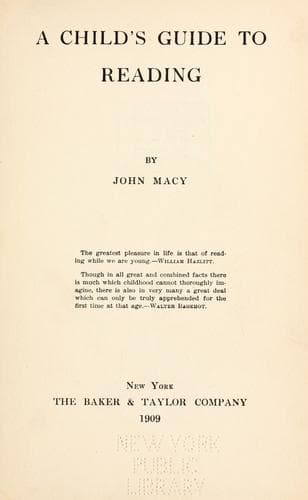
Books and reading; Children's literature -- Bibliography
At this point the Guide to Reading parts company with you and leaves
you in the hands of the economists, the historians, the chemists, the
philosophers. Special teachers and advisers will conduct you into those
subjects. They are organized subjects. The paths to them are steep but
well graded and paved. If you wander upon these paths without guidance
you will not harm yourself, and, if you do not try to discuss what you
do not understand, you will not harm anyone else. The list of works in
philosophy and science which I append includes some that I, an errant
reader, have stumbled into with pleasure and profit. I do not know
surely whether any one of them is the best in its subject or whether
it is the proper work to read first. I only know in general that a
civilized man should for his own pleasure and enlightenment set his
wits against a hard technical book once in a while for the sake of the
exercise, and that although for purposes of wisdom and happiness the
Literature of the Ages contains all that is necessary, everybody ought
to go a little way into some special subject that lies less in the
realm of literature than in the realm of science.
LIST OF WORKS IN SCIENCE AND PHILOSOPHY
_Supplementary to Chapter XIII_
In this list are a few volumes of scientific and philosophic works,
notable for their literary excellence, or for their clearness to the
general reader, or for the historical and human importance of the
author. There is no attempt at order or system except the alphabetical
sequence of authors. Some philosophic and scientific works will be
found in the list of essays, on page 192.
GRANT ALLEN. _The Story of the Plants._
In _Appleton’s Library of Useful Stories_.
MARCUS AURELIUS ANTONINUS. _Thoughts or Meditations._
In _Everyman’s Library_ and many cheap editions.
JOHN LUBBOCK (Lord Avebury). _The Beauties of Nature and the Wonders
of the World We Live In._ _The Use of Life._
A popular writer on scientific and philosophic subjects.
LIBERTY HYDE BAILEY. _First Lessons with Plants._ _Garden Making._
ROBERT STAWELL BALL. _The Earth’s Beginning._ _Star-Land: Being Talks
with Young People._
JOHN BURROUGHS. _Birds and Bees and Other Studies in Nature._
_Squirrels and Other Fur Bearers._
These books are especially suitable for young readers.
CHARLES TRIPLER CHILD. _The How and Why of Electricity._
For the uninformed reader.
JAMES DWIGHT DANA. _The Geological Story Briefly Told._
CHARLES ROBERT DARWIN. _On the Origin of Species._ _What Mr. Darwin
Saw in His Voyage Round the World in the Ship “Beagle.”_
The second of the two books named is especially for young readers.
The book from which it is taken, Darwin’s “Journal” of the voyage is
in _Everyman’s Library_. For expositions of Darwin’s theories, see
Huxley’s “Darwiniana,” Wallace’s “Darwinism” and David Starr Jordan’s
“Footnotes to Evolution.”
GOLDSWORTHY LOWES DICKINSON. _The Greek View of Life._ _A Modern
Symposium._
Public-domain text, read in full here on John Shaqi.
Reviews
Reviews
No reviews yet
Be the first to share your thoughts on this work.
Elsewhere in the archive
Join the Discussion
Join the discussion
Sign in to leave a comment or review.
Sign InorCreate an account