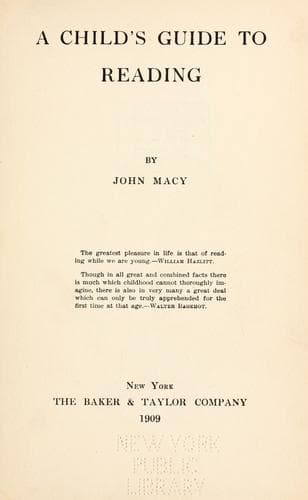
Books and reading; Children's literature -- Bibliography
“For the fatherland of the English race we must look far away from
England itself. In the fifth century after the birth of Christ, the
one country which we know to have borne the name of Angeln or the
Engleland lay in the district which we now call Sleswick, a district
in the heart of the peninsula which parts the Baltic from the northern
seas. Its pleasant pastures, its black-timbered homesteads, its prim
little townships, looking down on inlets of purple water, were then but
a wild waste of heather and sand, girt along the coast with sunless
woodland, broken here and there by meadows which crept down to the
marshes and the sea.”
Could any historic novel, we may say could any _other_ historic
romance, open more enticingly? Here is rich promise, promise of
the picturesque, promise of the eloquent phrase, promise of a
sympathetic history of a people who are delvers in the soil, dwellers
in homesteads, and no mere pawns in the game of kings. This is to
be a history of a people. We shall learn of their great common
characteristics; we shall understand them as we understand a family,
and every adventure from King Alfred’s burning of the cakes to Clive’s
conquest of India will spring like the episodes in a great plot from
the character of the English race.
From Green’s History, as a whole, we shall learn what are the
important things in the history of any people. His admirable sense
of the relative values of events and persons informs his work with a
philosophy of life that is just, wholesome, and salutary for a young
person to be imbued with who must look out on the daily struggle about
him, read the endless hodge-podge of newspaper chronicle, and weigh
the day’s events wisely. Green fulfils the ideal which he sets forth
in the preface: “It is the reproach of historians that they have too
often turned history into a mere record of the butchery of men by their
fellow men. But war plays a small part in the real history of European
nations, and in that of England its part is smaller than in any....
If I have said little of the glories of Cressy, it is because I have
dwelt much on the wrong and misery which prompted the verse of Longland
and the preaching of Ball. But on the other hand, I have never shrunk
from telling at length of the triumphs of peace. I have restored to
their place among the achievements of Englishmen the ‘Faerie Queene’
and the ‘Novum Organum.’ I have set Shakespeare among the heroes of
the Elizabethan age.... I have had to find a place for figures little
heeded in common history--the figures of the missionary, the poet, the
printer, the merchant, the philosopher.”
Public-domain text, read in full here on John Shaqi.
Reviews
Reviews
No reviews yet
Be the first to share your thoughts on this work.
Elsewhere in the archive
Join the Discussion
Join the discussion
Sign in to leave a comment or review.
Sign InorCreate an account