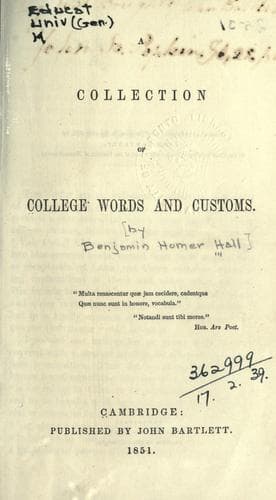
A Collection of College Words and CustomsHall, Benjamin Homer
History
A Collection of College Words and Customs
Hall, Benjamin Homer
College students -- United States -- Language; English language -- United States -- Slang; Slang
After referring to the instance mentioned above, in which corporal
punishment was inflicted at Harvard College, the author speaks as
follows, in reference to the same subject, as connected with the
English universities. "The excerpts from the body of Oxford
statutes, printed in the very year when this College was founded,
threaten corporal punishment to persons of the proper age,--that
is, below the age of eighteen,--for a variety of offences; and
among the rest for disrespect to Seniors, for frequenting places
where 'vinum aut quivis alius potus aut herba Nicotiana ordinarie
venditur,' for coming home to their rooms after the great Tom or
bell of Christ's Church had sounded, and for playing football
within the University precincts or in the city streets. But the
statutes of Trinity College, Cambridge, contain more remarkable
rules, which are in theory still valid, although obsolete in fact.
All the scholars, it is there said, who are absent from
prayers,--Bachelors excepted,--if over eighteen years of age,
'shall be fined a half-penny, but if they have not completed the
year of their age above mentioned, they shall be chastised with
rods in the hall on Friday.' At this chastisement all
undergraduates were required to be lookers on, the Dean having the
rod of punishment in his hand; and it was provided also, that
whosoever should not answer to his name on this occasion, if a
boy, should be flogged on Saturday. No doubt this rigor towards
the younger members of the society was handed down from the
monastic forms which education took in the earlier schools of the
Middle Ages. And an advance in the age of admission, as well as a
change in the tone of treatment of the young, may account for this
system being laid aside at the universities; although, as is well
known, it continues to flourish at the great public schools of
England."--pp. 49-51.
CORPORATION. The general government of colleges and universities
is usually vested in a corporation aggregate, which is preserved
by a succession of members. "The President and Fellows of Harvard
College," says Mr. Quincy in his History of Harvard University,
"being the only Corporation in the Province, and so continuing
during the whole of the seventeenth century, they early assumed,
and had by common usage conceded to them, the name of "_The
Corporation_," by which they designate themselves in all the early
records. Their proceedings are recorded as being done 'at a
meeting of _the Corporation_,' or introduced by the formula, 'It
is ordered by _the Corporation_,' without stating the number or
the names of the members present, until April 19th, 1675, when,
under President Oakes, the names of those present were first
entered on the records, and afterwards they were frequently,
though not uniformly, inserted."--Vol. I. p. 274.
Public-domain text, read in full here on John Shaqi.
Reviews
Reviews
No reviews yet
Be the first to share your thoughts on this work.
Elsewhere in the archive
Join the Discussion
Join the discussion
Sign in to leave a comment or review.
Sign InorCreate an account