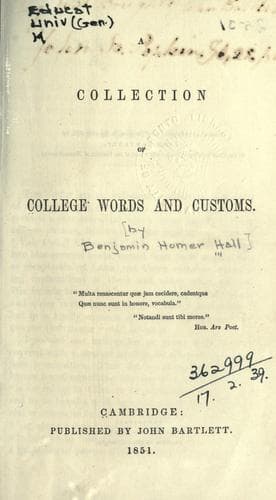
A Collection of College Words and CustomsHall, Benjamin Homer
History
A Collection of College Words and Customs
Hall, Benjamin Homer
College students -- United States -- Language; English language -- United States -- Slang; Slang
2. To provide for poor students by an exhibition. (See EXHIBITION,
second meaning.) An instance of this use is given in the Gradus ad
Cantabrigiam, where one Antony Wood says of Bishop Longland, "He
was a special friend to the University, in maintaining its
privileges and in _exhibiting_ to the wants of certain scholars."
In Mr. Peirce's History of Harvard University occurs this passage,
in an account of the will of the Hon. William Stoughton: "He
bequeathed a pasture in Dorchester, containing twenty-three acres
and four acres of marsh, 'the income of both to be _exhibited_, in
the first place, to a scholar of the town of Dorchester, and if
there be none such, to one of the town of Milton, and in want of
such, then to any other well deserving that shall be most needy.'"
--p. 77.
EXHIBITION. In colleges, a public literary and oratorical display.
The exercises at _exhibitions_ are original compositions, prose
translations from the English into Greek and Latin, and from other
languages into the English, metrical versions, dialogues, &c.
At Harvard College, in the year 1760, it was voted, "that twice in
a year, in the spring and fall, each class should recite to their
Tutors, in the presence of the President, Professors, and Tutors,
in the several books in which they are reciting to their
respective Tutors, and that publicly in the College Hall or
Chapel." The next year, the Overseers being informed "that the
students are not required to translate English into Latin nor
Latin into English," their committee "thought it would be
convenient that specimens of such translations and other
performances in classical and polite literature should be from
time to time laid before" their board. A vote passed the Board of
Overseers recommending to the Corporation a conformity to these
suggestions; but it was not until the year 1766 that a law was
formally enacted in both boards, "that twice in the year, viz. at
the semiannual visitation of the committee of the Overseers, some
of the scholars, at the direction of the President and Tutors,
shall publicly exhibit specimens of their proficiency, by
pronouncing orations and delivering dialogues, either in English
or in one of the learned languages, or hearing a forensic
disputation, or such other exercises as the President and Tutors
shall direct."--_Quincy's Hist. Harv. Univ._, Vol. II. pp.
128-132.
A few years after this, two more exhibitions were added, and were
so arranged as to fall one in each quarter of the College year.
The last year in which there were four exhibitions was 1789. After
this time there were three exhibitions during the year until 1849,
when one was omitted, since which time the original plan has been
adopted.
Public-domain text, read in full here on John Shaqi.
Reviews
Reviews
No reviews yet
Be the first to share your thoughts on this work.
Elsewhere in the archive
Join the Discussion
Join the discussion
Sign in to leave a comment or review.
Sign InorCreate an account