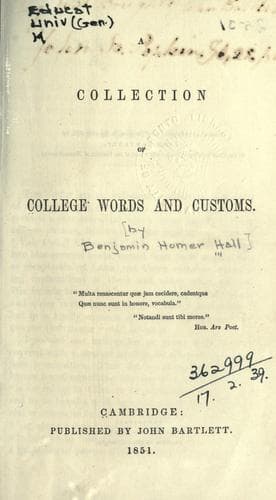
A Collection of College Words and CustomsHall, Benjamin Homer
History
A Collection of College Words and Customs
Hall, Benjamin Homer
College students -- United States -- Language; English language -- United States -- Slang; Slang
Those who refused to comply with these regulations were not
allowed to remain in College, as appears from the following
circumstance, which happened about the year 1790. A young man from
the West Indies, of wealthy and highly respectable parents,
entered Freshman, and soon after, being ordered by a member of one
of the upper classes to go upon an errand for him, refused, at the
same time saying, that if he had known it was the custom to
require the lower class to wait on the other classes, he would
have brought a slave with him to perform his share of these
duties. In the common phrase of the day, he was _hoisted_, i.e.
complained of to a tutor, and on being told that he could not
remain at College if he did not comply with its regulations, he
took up his connections and returned home.
With reference to some of the observances which were in vogue at
Harvard College in the year 1794, the recollections of Professor
Sidney Willard are these:--
"It was the practice, at the time of my entrance at College, for
the Sophomore Class, by a member selected for the purpose, to
communicate to the Freshmen, in the Chapel, 'the Customs,' so
called; the Freshmen being required to 'keep their places in their
seats, and attend with decency to the reading.' These customs had
been handed down from remote times, with some modifications not
essentially changing them. Not many days after our seats were
assigned to us in the Chapel, we were directed to remain after
evening prayers and attend to the reading of the customs; which
direction was accordingly complied with, and they were read and
listened to with decorum and gravity. Whether the ancient customs
of outward respect, which forbade a Freshman 'to wear his hat in
the College yard, unless it rains, hails, or snows, provided he be
on foot, and have not both hands full,' as if the ground on which
he trod and the atmosphere around him were consecrated, and the
article which extends the same prohibition to all undergraduates,
when any of the governors of the College are in the yard, were
read, I cannot say; but I think they were not; for it would have
disturbed that gravity which I am confident was preserved during
the whole reading. These prescripts, after a long period of
obsolescence, had become entirely obsolete.
Public-domain text, read in full here on John Shaqi.
Reviews
Reviews
No reviews yet
Be the first to share your thoughts on this work.
Elsewhere in the archive
Join the Discussion
Join the discussion
Sign in to leave a comment or review.
Sign InorCreate an account