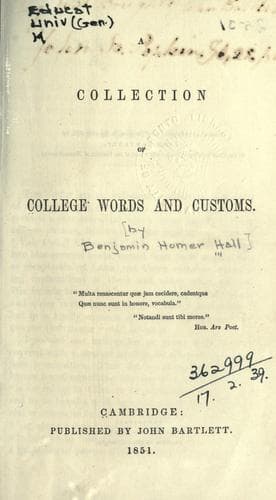
A Collection of College Words and CustomsHall, Benjamin Homer
History
A Collection of College Words and Customs
Hall, Benjamin Homer
College students -- United States -- Language; English language -- United States -- Slang; Slang
HARVARD WASHINGTON CORPS. From a memorandum on a fly leaf of an
old Triennial Catalogue, it would appear that a military company
was first established among the students of Harvard College about
the year 1769, and that its first captain was Mr. William Wetmore,
a graduate of the Class of 1770. The motto which it then assumed,
and continued to bear through every period of its existence, was,
"Tam Marti quam Mercurio." It was called at that time the Marti
Mercurian Band. The prescribed uniform was a blue coat, the skirts
turned with white, nankeen breeches, white stockings, top-boots,
and a cocked hat. This association continued for nearly twenty
years from the time of its organization, but the chivalrous spirit
which had called it into existence seems at the end of that time
to have faded away. The last captain, it is believed, was Mr.
Solomon Vose, a graduate of the class of 1787.
Under the auspices of Governor Gerry, in December of the year
1811, it was revived, and through his influence received a new
loan of arms from the State, taking at the same time the name of
the Harvard Washington Corps. In 1812, Mr. George Thacher was
appointed its commander. The members of the company wore a blue
coat, white vest, white pantaloons, white gaiters, a common black
hat, and around the waist a white belt, which was always kept very
neat, and to which were attached a bayonet and cartridge-box. The
officers wore the same dress, with the exceptions of a sash
instead of the belt, and a chapeau in place of the hat. Soon after
this reorganization, in the fall of 1812, a banner, with the arms
of the College on one side and the arms of the State on the other,
was presented by the beautiful Miss Mellen, daughter of Judge
Mellen of Cambridge, in the name of the ladies of that place. The
presentation took place before the door of her father's house.
Appropriate addresses were made, both by the fair donor and the
captain of the company. Mr. Frisbie, a Professor in the College,
who was at that time engaged to Miss Mellen, whom he afterwards
married, recited on the occasion the following verses impromptu,
which were received with great _eclat_.
"The standard's victory's leading star,
'T is danger to forsake it;
How altered are the scenes of war,
They're vanquished now who take it."
A writer in the Harvardiana, 1836, referring to this banner, says:
"The gilded banner now moulders away in inglorious quiet, in the
dusty retirement of a Senior Sophister's study. What a desecration
for that 'flag by angel hands to valor given'!"[40] Within the
last two years it has wholly disappeared from its accustomed
resting-place. Though departed, its memory will be ever dear to
those who saw it in its better days, and under its shadow enjoyed
many of the proudest moments of college life.
Public-domain text, read in full here on John Shaqi.
Reviews
Reviews
No reviews yet
Be the first to share your thoughts on this work.
Elsewhere in the archive
Join the Discussion
Join the discussion
Sign in to leave a comment or review.
Sign InorCreate an account