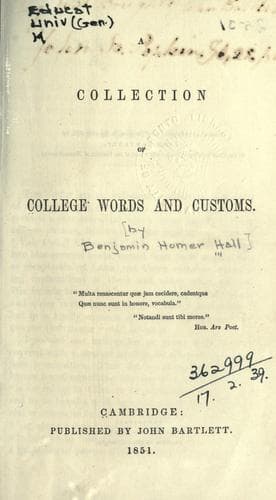
A Collection of College Words and CustomsHall, Benjamin Homer
History
A Collection of College Words and Customs
Hall, Benjamin Homer
College students -- United States -- Language; English language -- United States -- Slang; Slang
The various means which are made use of in _hazing_ the Freshmen
are enumerated in part below. In the first passage, a Sophomore
speaks in soliloquy.
I am a man,
Have human feelings, though mistaken Fresh
Affirmed I was a savage or a brute,
When I did dash cold water in their necks,
Discharged green squashes through their window-panes,
And stript their beds of soft, luxurious sheets,
Placing instead harsh briers and rough sticks,
So that their sluggish bodies might not sleep,
Unroused by morning bell; or when perforce,
From leaden syringe, engine of fierce might,
I drave black ink upon their ruffle shirts,
Or drenched with showers of melancholy hue,
The new-fledged dickey peering o'er the stock,
Fit emblem of a young ambitious mind!
_Harvardiana_, Vol. III. p. 254.
A Freshman writes thus on the subject:--
The Sophs did nothing all the first fortnight but torment the
Fresh, as they call us. They would come to our rooms with masks
on, and frighten us dreadfully; and sometimes squirt water through
our keyholes, or throw a whole pailful on to one of us from the
upper windows.--_Harvardiana_, Vol. III. p. 76.
HEAD OF THE HOUSE. The generic name for the highest officer of a
college in the English Universities.
The Master of the College, or "_Head of the House_," is a D.D. who
has been a Fellow.--_Bristed's Five Years in an Eng. Univ._, Ed.
2d, p. 16.
The _heads of houses_ [are] styled, according to the usage of the
college, President, Master, Principal, Provost, Warden, or Rector.
--_Oxford Guide_, 1847, p. xiii.
Written often simply _Head_.
The "_Head_," as he is called generically, of an Oxford college,
is a greater man than the uninitiated suppose.--_De Quincey's Life
and Manners_, p. 244.
The new _Head_ was a gentleman of most commanding personal
appearance.--_Bristed's Five Years in an Eng. Univ._, Ed. 2d, p.
87.
HEADSHIP. The office and place of head or president of a college.
Most of the college _Headships_ are not at the disposal of the
Crown.--_Bristed's Five Years in an Eng. Univ._, Ed. 2d, note, p.
89, and _errata_.
The _Headships_ of the colleges are, with the exception of
Worcester, filled by one chosen by the Fellows from among
themselves, or one who has been a Fellow.--_Oxford Guide_, Ed.
1847, p. xiv.
HEADS OUT. At Princeton College, the cry when anything occurs in
the _Campus_. Used, also, to give the alarm when a professor or
tutor is about to interrupt a spree.
See CAMPUS.
HEBDOMADAL BOARD. At Oxford, the local governing authority of the
University, composed of the Heads of colleges and the two
Proctors, and expressing itself through the Vice-Chancellor. An
institution of Charles I.'s time, it has possessed, since the year
1631, "the sole initiative power in the legislation of the
University, and the chief share in its administration." Its
meetings are held weekly, whence the name.--_Oxford Guide.
Literary World_, Vol. XII., p. 223.
Public-domain text, read in full here on John Shaqi.
Reviews
Reviews
No reviews yet
Be the first to share your thoughts on this work.
Elsewhere in the archive
Join the Discussion
Join the discussion
Sign in to leave a comment or review.
Sign InorCreate an account