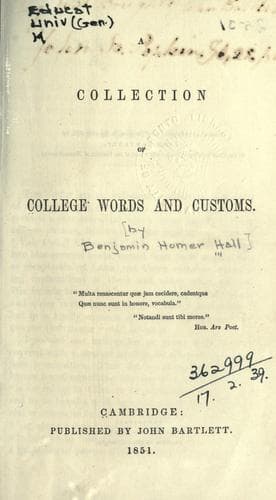
A Collection of College Words and CustomsHall, Benjamin Homer
History
A Collection of College Words and Customs
Hall, Benjamin Homer
College students -- United States -- Language; English language -- United States -- Slang; Slang
The Flag-ship for the year 1815 was a large marquee, called "The
Good Ship Harvard," which was moored in the woods, near the place
where the residence of the Hon. John G. Palfrey now stands. The
floor was arranged like the deck of a man-of-war, being divided
into the main and quarter decks. The latter was occupied by the
admiral, and no one was allowed to be there with him without
special order or permission. In his sway he was very despotic, and
on board ship might often have been seen reclining on his couch,
attended by two of his subordinates (classmates), who made his
slumbers pleasant by guarding his sacred person from the visits of
any stray mosquito, and kept him cool by the vibrations of a fan.
The marquee stood for several weeks, during which time meetings
were frequently held in it. At the command of the admiral, the
boatswain would sound his whistle in front of Holworthy Hall, the
building where the Seniors then, as now, resided, and the student
sailors, issuing forth, would form in procession, and march to the
place of meeting, there to await further orders. If the members of
the Navy remained on board ship over night, those who had received
appointments at Commencement, then called the "Marines," were
obliged to keep guard while the members slept or caroused.
The operations of the Navy were usually closed with an excursion
down the harbor. A vessel well stocked with certain kinds of
provisions afforded, with some assistance from the stores of old
Ocean, the requisites for a grand clam-bake or a mammoth chowder.
The spot usually selected for this entertainment was the shores of
Cape Cod. On the third day the party usually returned from their
voyage, and their entry into Cambridge was generally accompanied
with no little noise and disorder. The Admiral then appointed
privately his successor, and the Navy was disbanded for the year.
The exercises of the association varied from year to year. Many of
the old customs gradually went out of fashion, until finally but
little of the original Navy remained. The officers were, as usual,
appointed yearly, but the power of appointing them was transferred
to the class, and a public parade was substituted for the forms
and ceremonies once peculiar to the society. The excursion down
the harbor was omitted for the first time the present year,[57]
and the last procession made its appearance in the year 1846.
Public-domain text, read in full here on John Shaqi.
Reviews
Reviews
No reviews yet
Be the first to share your thoughts on this work.
Elsewhere in the archive
Join the Discussion
Join the discussion
Sign in to leave a comment or review.
Sign InorCreate an account