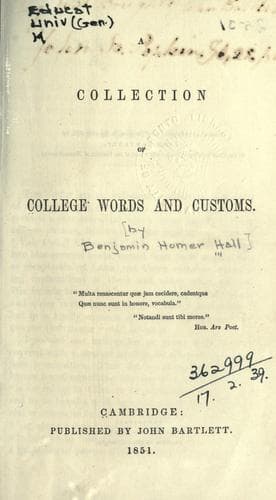
A Collection of College Words and CustomsHall, Benjamin Homer
History
A Collection of College Words and Customs
Hall, Benjamin Homer
College students -- United States -- Language; English language -- United States -- Slang; Slang
the houses of the Professors, separated about seven o'clock, P.M."
At first like a badger the Freshman dug,
Fed on Latin and Greek, in his room kept snug;
And he fondly hoped that on _Navy Club_ day
The highest spade he might bear away.
_MS. Poem_, F.E. Felton, Harv. Coll.
NECK. To _run one's neck_, at Williams College, to trust to luck
for the success of any undertaking.
NESCIO. Latin; literally, _I do not know_. At the University of
Cambridge, England, _to sport a nescio_, to shake the head, a
signal that one does not understand or is ignorant of the subject.
"After the Senate-House examination for degrees," says Grose, in
his Classical Dictionary of the Vulgar Tongue, "the students
proceed to the schools, to be questioned by the proctor. According
to custom immemorial, the answers _must_ be _Nescio_. The
following is a translated specimen:--
"_Ques._ What is your, name? _Ans._ I do not know.
"_Ques._ What is the name of this University? _Ans._ I do not
know.
"_Ques._ Who was your father? _Ans._ I do not know.
"The last is probably the only true answer of the three!"
NEWLING. In the German universities, a Freshman; one in his first
half-year.
NEWY. At Princeton College, a fresh arrival.
NIGHTGOWN. A dressing-gown; a _deshabille_.
No student shall appear within the limits of the College, or town
of Cambridge, in any other dress than in the uniform belonging to
his respective class, unless he shall have on a _nightgown_, or
such an outside garment as may be necessary over a coat.--_Laws
Harv. Coll._, 1790.
NOBLEMAN. In the English universities, among the Undergraduates,
the nobleman enjoys privileges and exemptions not accorded to
others. At Oxford he wears a black-silk gown with full sleeves
"couped" at the elbows, and a velvet cap with gold tassel, except
on full-dress occasions, when his habit is of violet-figured
damask silk, richly bedight with gold lace. At Cambridge he wears
the plain black-silk gown and the hat of an M.A., except on feast
days and state occasions, when he appears in a gown still more
gorgeous than that of a Fellow-Commoner.--_Oxford Guide. Bristed_.
NO END OF. Bristed records this phrase as an intensive peculiar to
the English Cantabs. Its import is obvious "They have _no end of_
tin; i.e. a great deal of money. He is _no end of_ a fool; i.e.
the greatest fool possible."--_Five Years in an Eng. Univ._, Ed.
2d, p. 24.
The use of this expression, with a similar signification, is
common in some portions of the United States.
NON ENS. Latin; literally _not being_. At the University of
Cambridge, Eng., one who has not been matriculated, though he has
resided some time at the University; consequently is not
considered as having any being. A Freshman in embryo.--_Grad. ad
Cantab._
NON PARAVI. Latin; literally, _I have not prepared_. When Latin
was spoken in the American colleges, this excuse was commonly
given by scholars not prepared for recitation.
Public-domain text, read in full here on John Shaqi.
Reviews
Reviews
No reviews yet
Be the first to share your thoughts on this work.
Elsewhere in the archive
Join the Discussion
Join the discussion
Sign in to leave a comment or review.
Sign InorCreate an account