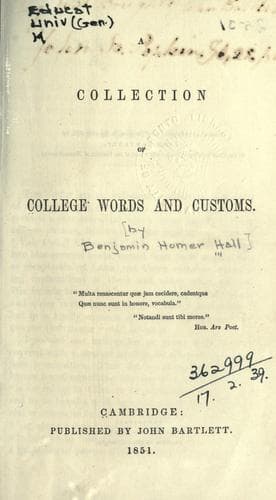
A Collection of College Words and CustomsHall, Benjamin Homer
History
A Collection of College Words and Customs
Hall, Benjamin Homer
College students -- United States -- Language; English language -- United States -- Slang; Slang
"Its objects," says Mr. Quincy, in his History of Harvard
University, "were the 'promotion of literature and friendly
intercourse among scholars'; and its name and motto indicate, that
'philosophy, including therein religion as well as ethics, is
worthy of cultivation as the guide of life.' This society took an
early and a deep root in the University; its exercises became
public, and admittance into it an object of ambition; but the
'discrimination' which its selection of members made among
students, became an early subject of question and discontent. In
October, 1789, a committee of the Overseers, of which John Hancock
was chairman, reported to that board, 'that there is an
institution in the University, with the nature of which the
government is not acquainted, which tends to make a discrimination
among the students'; and submitted to the board 'the propriety of
inquiring into its nature and designs.' The subject occasioned
considerable debate, and a petition, of the nature of a complaint
against the society, by a number of the members of the Senior
Class, having been presented, its consideration was postponed, and
it was committed; but it does not appear from the records, that
any further notice was taken of the petition. The influence of the
society was upon the whole deemed salutary, since literary merit
was assumed as the principle on which its members were selected;
and, so far, its influence harmonized with the honorable motives
to exertion which have ever been held out to the students by the
laws and usages of the College. In process of time, its catalogue
included almost every member of the Immediate Government, and
fairness in the selection of members has been in a great degree
secured by the practice it has adopted, of ascertaining those in
every class who stand the highest, in point of conduct and
scholarship, according to the estimates of the Faculty of the
College, and of generally regarding those estimates. Having
gradually increased in numbers, popularity, and importance, the
day after Commencement was adopted for its annual celebration.
These occasions have uniformly attracted a highly intelligent and
cultivated audience, having been marked by a display of learning
and eloquence, and having enriched the literature of the country
with some of its brightest gems."--Vol. II. p. 398.
Public-domain text, read in full here on John Shaqi.
Reviews
Reviews
No reviews yet
Be the first to share your thoughts on this work.
Elsewhere in the archive
Join the Discussion
Join the discussion
Sign in to leave a comment or review.
Sign InorCreate an account