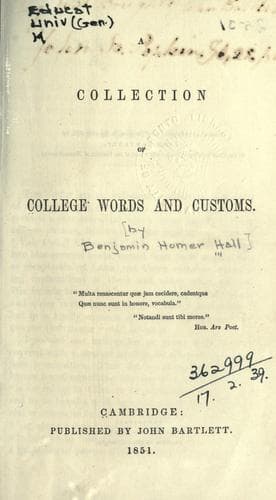
A Collection of College Words and CustomsHall, Benjamin Homer
History
A Collection of College Words and Customs
Hall, Benjamin Homer
College students -- United States -- Language; English language -- United States -- Slang; Slang
The disputations were always in Latin, and continued to be a part
of the exercises of Commencement until the year 1820. The orations
were in Latin, Greek, Hebrew, and sometimes French; in 1818 a
Spanish oration was delivered at the Commencement for that year by
Mr. George Osborne. The first English oration was made by Mr.
Jedidiah Huntington, in the year 1763, and the first English poem
by Mr. John Davis, in 1781. The last Latin syllogisms were in
1792, on the subjects, "Materia cogitare non potest," and "Nil
nisi ignis naturâ est fluidum." The first year in which the
performers spoke without a prompter was 1837. There were no
Master's exercises for the first time in 1844. To prevent
improprieties, in the year 1760, "the duty of inspecting the
performances on the day," says Quincy, "and expunging all
exceptionable parts, was assigned to the President; on whom it was
particularly enjoined 'to put an end to the practice of addressing
the female sex.'" At a later period, in 1792, by referring to the
"Order of the Exercises of Commencement," we find that in the
concluding oration "honorable notice is taken, from year to year,
of those who have been the principal Benefactors of the
University." The practice is now discontinued.
At the first Commencement, all the magistrates, elders, and
invited guests who were present "dined," says Winthrop in his
Journal, Vol. II. pp. 87, 88, "at the College with the scholars'
ordinary commons, which was done on purpose for the students'
encouragement, &c., and it gave good content to all." After
dinner, a Psalm was usually sung. In 1685, at Commencement, Sewall
says: "After dinner ye 3d part of ye 103d Ps. was sung in ye
Hall." The seventy-eighth Psalm was the one usually sung, an
account of which will be found under that title. The Senior Class
usually waited on the table on Commencement Day. After dinner,
they were allowed to take what provisions were left, and eat them
at their rooms, or in the hall. This custom was not discontinued
until the year 1812.
In 1754, owing to the expensive habits worn on Commencement Day, a
law was passed, ordering that on that day "every candidate for his
degree appear in black, or dark blue, or gray clothes; and that no
one wear any silk night-gowns; and that any candidate, who shall
appear dressed contrary to such regulations, may not expect his
degree." At present, on Commencement Day, every candidate for a
first degree wears, according to the law, "a black dress and the
usual black gown."
Public-domain text, read in full here on John Shaqi.
Reviews
Reviews
No reviews yet
Be the first to share your thoughts on this work.
Elsewhere in the archive
Join the Discussion
Join the discussion
Sign in to leave a comment or review.
Sign InorCreate an account