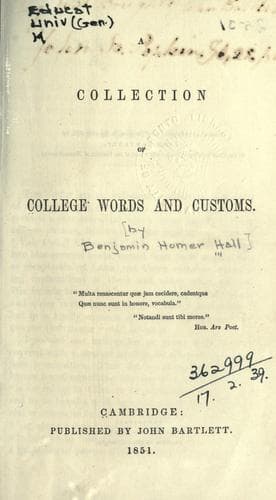
A Collection of College Words and CustomsHall, Benjamin Homer
History
A Collection of College Words and Customs
Hall, Benjamin Homer
College students -- United States -- Language; English language -- United States -- Slang; Slang
An idea of the quality of commons may be formed from the following
accounts furnished by Dr. Holyoke and Judge Wingate. According to
the former of these gentlemen, who graduated in 1746, the
"breakfast was two sizings of bread and a cue of beer"; and
"evening commons were a pye." The latter, who graduated thirteen
years after, says: "As to the commons, there were in the morning
none while I was in College. At dinner, we had, of rather ordinary
quality, a sufficiency of meat of some kind, either baked or
boiled; and at supper, we had either a pint of milk and half a
biscuit, or a meat pye of some other kind. Such were the commons
in the hall in my day. They were rather ordinary; but I was young
and hearty, and could live comfortably upon them. I had some
classmates who paid for their commons and never entered the hall
while they belonged to the College. We were allowed at dinner a
cue of beer, which was a half-pint, and a sizing of bread, which I
cannot describe to you. It was quite sufficient for one dinner."
By a vote of the Corporation in 1750, a law was passed, declaring
"that the quantity of commons be as hath been usual, viz. two
sizes of bread in the morning; one pound of meat at dinner, with
sufficient sauce" (vegetables), "and a half a pint of beer; and at
night that a part pie be of the same quantity as usual, and also
half a pint of beer; and that the supper messes be but of four
parts, though the dinner messes be of six." This agrees in
substance with the accounts given above. The consequence of such
diet was, "that the sons of the rich," says Mr. Quincy,
"accustomed to better fare, paid for commons, which they would not
eat, and never entered the hall; while the students whose
resources did not admit of such an evasion were perpetually
dissatisfied."
About ten years after, another law was made, "to restrain scholars
from breakfasting in the houses of town's people," and provision
was made "for their being accommodated with breakfast in the hall,
either milk, chocolate, tea, or coffee, as they should
respectively choose." They were allowed, however, to provide
themselves with breakfasts in their own chambers, but not to
breakfast in one another's chambers. From this period breakfast
was as regularly provided in commons as dinner, but it was not
until about the year 1807 that an evening meal was also regularly
provided.
Public-domain text, read in full here on John Shaqi.
Reviews
Reviews
No reviews yet
Be the first to share your thoughts on this work.
Elsewhere in the archive
Join the Discussion
Join the discussion
Sign in to leave a comment or review.
Sign InorCreate an account