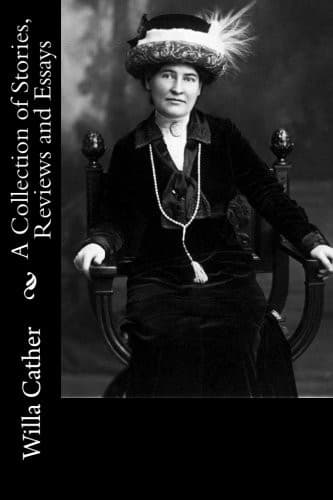
A Collection of Stories, Reviews and EssaysCather, Willa
General
A Collection of Stories, Reviews and Essays
Cather, Willa
Essays; Short stories; United States -- Social life and customs -- Fiction
Mrs. Wooley said she sometimes felt afraid he might disinherit his
children, as rich people often did, and make talk; but she hoped for
the best. Whatever came to Annie, she prayed it might not be in the
form of taxable property.
IV
Late in September Wanning grew suddenly worse. His family hurried
home, and he was put to bed in his house in Orange. He kept asking
the doctors when he could get back to the office, but he lived only
eight days.
The morning after his father's funeral, Harold went to the office to
consult Wanning's partners and to read the will. Everything in the
will was as it should be. There were no surprises except a codicil
in the form of a letter to Mrs. Wanning, dated July 8th, requesting
that out of the estate she should pay the sum of one thousand
dollars to his stenographer, Annie Wooley, "in recognition of her
faithful services."
"I thought Miss Doane was my father's stenographer," Harold
exclaimed.
Alec McQuiston looked embarrassed and spoke in a low, guarded tone.
"She was, for years. But this spring,--" he hesitated.
McQuiston loved a scandal. He leaned across his desk toward Harold.
"This spring your father put this little girl, Miss Wooley, a
copyist, utterly inexperienced, in Miss Doane's place. Miss Doane
was indignant and left us. The change made comment here in the
office. It was slightly--No, I will be frank with you, Harold, it
was very irregular."
Harold also looked grave. "What could my father have meant by such a
request as this to my mother?"
The silver haired senior partner flushed and spoke as if he were
trying to break something gently.
"I don't understand it, my boy. But I think, indeed I prefer to
think, that your father was not quite himself all this summer. A man
like your father does not, in his right senses, find pleasure in the
society of an ignorant, common little girl. He does not make a
practise of keeping her at the office after hours, often until eight
o'clock, or take her to restaurants and to the theater with him;
not, at least, in a slanderous city like New York."
Harold flinched before McQuiston's meaning gaze and turned aside in
pained silence. He knew, as a dramatist, that there are dark
chapters in all men's lives, and this but too clearly explained why
his father had stayed in town all summer instead of joining his
family.
McQuiston asked if he should ring for Annie Wooley.
Harold drew himself up. "No. Why should I see her? I prefer not to.
But with your permission, Mr. McQuiston, I will take charge of this
request to my mother. It could only give her pain, and might awaken
doubts in her mind."
"We hardly know," murmured the senior partner, "where an
investigation would lead us. Technically, of course, I cannot agree
with you. But if, as one of the executors of the will, you wish to
assume personal responsibility for this bequest, under the
circumstances--irregularities beget irregularities."
"My first duty to my father," said Harold, "is to protect my
mother."
Public-domain text, read in full here on John Shaqi.
Reviews
Reviews
No reviews yet
Be the first to share your thoughts on this work.
Elsewhere in the archive
Join the Discussion
Join the discussion
Sign in to leave a comment or review.
Sign InorCreate an account