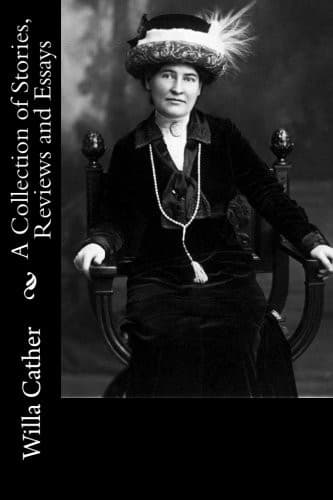
A Collection of Stories, Reviews and EssaysCather, Willa
General
A Collection of Stories, Reviews and Essays
Cather, Willa
Essays; Short stories; United States -- Social life and customs -- Fiction
All the Baptist ladies liked Nell, even those who criticized her
most severely, but the three who were first in fighting the battles
of our little church, who held it together by their prayers and the
labor of their hands, watched over her as they did over Mrs. Dow's
century-plant before it blossomed. They looked for her on Sunday
morning and smiled at her as she hurried, always a little late, up
to the choir. When she rose and stood behind the organ and sang
"There Is a Green Hill," one could see Mrs. Dow and Mrs. Freeze
settle back in their accustomed seats and look up at her as if she
had just come from that hill and had brought them glad tidings.
It was because I sang contralto, or, as we said, alto, in the
Baptist choir that Nell and I became friends. She was so gay and
grown up, so busy with parties and dances and picnics, that I would
scarcely have seen much of her had we not sung together. She liked
me better than she did any of the older girls, who tried clumsily to
be like her, and I felt almost as solicitous and admiring as did
Mrs. Dow and Mrs. Spinny. I think even then I must have loved to see
her bloom and glow, and I loved to hear her sing, in "The Ninety and
Nine,"
But one was out on the hills away
in her sweet, strong voice. Nell had never had a singing lesson, but
she had sung from the time she could talk, and Mrs. Dow used fondly
to say that it was singing so much that made her figure so pretty.
After I went into the choir it was found to be easier to get Nelly
to choir practice. If I stopped outside her gate on my way to church
and coaxed her, she usually laughed, ran in for her hat and jacket,
and went along with me. The three old ladies fostered our
friendship, and because I was "quiet," they esteemed me a good
influence for Nelly. This view was propounded in a sewing-circle
discussion and, leaking down to us through our mothers, greatly
amused us. Dear old ladies! It was so manifestly for what Nell was
that they loved her, and yet they were always looking for
"influences" to change her.
The "Queen Esther" performance had cost us three months of hard
practice, and it was not easy to keep Nell up to attending the
tedious rehearsals. Some of the boys we knew were in the chorus of
Assyrian youths, but the solo cast was made up of older people, and
Nell found them very poky. We gave the cantata in the Baptist church
on Christmas eve, "to a crowded house," as the Riverbend "Messenger"
truly chronicled. The country folk for miles about had come in
through a deep snow, and their teams and wagons stood in a long row
at the hitch-bars on each side of the church door. It was certainly
Nelly's night, for however much the tenor--he was her schoolmaster,
and naturally thought poorly of her--might try to eclipse her in his
dolorous solos about the rivers of Babylon, there could be no doubt
as to whom the people had come to hear--and to see.
Public-domain text, read in full here on John Shaqi.
Reviews
Reviews
No reviews yet
Be the first to share your thoughts on this work.
Elsewhere in the archive
Join the Discussion
Join the discussion
Sign in to leave a comment or review.
Sign InorCreate an account