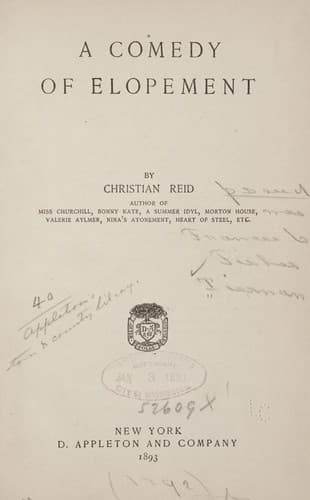
Florida -- Fiction; Man-woman relationships -- Fiction; Young women -- Fiction
But even as he scornfully asked the question he knew that it was
not so; that the spell of this face had its root deep in the past,
in that golden evening when he sat under the orange trees and tried
in vain to shake the grateful loyalty of a child. He knew now that
he had never forgotten that child, and the deep impression which
her absolute unselfishness had made on him, an impression deeper
because it had been contrasted with such utter selfishness on the
part of another. He had seemed to come very near to that little
maiden of the past in the hour when her nature and her heart
had been, as it were, laid bare before him; and so it was to no
stranger that he had so quickly surrendered his own heart, which
had long been swept and garnished and empty of any occupant.
Meanwhile Mrs. Meredith was clamoring for another song. “You are
surely not going to stop with one!” she cried. “We want another,
and yet another--don’t we, Aimée?”
“Just as many as Mr. Kyrle will give us,” responded Aimée, smiling.
It was easier to sing than to talk; so Kyrle again lifted his
voice, this time in a Spanish serenade as full of the spirit of
passionate romance as a Spanish night. But something had gone from
the singer’s voice, and, charming as was the song, no one was moved
and thrilled as by the first.
IV.
Fanny Meredith was right in saying that the Joscelyns watched
Aimée and every man who approached her like dragons. And from
their point of view, this was natural enough. Had not Aimée’s
fortune lifted them out of poverty and the embarrassments resulting
therefrom, to a condition of affluence where all things became
easy and agreeable? And could they be expected to surrender the
advantages of this fortune without a struggle? It was true that
they had enjoyed these advantages for five or six years, in which
time Major Joscelyn, through whose hands the income passed, had
made not a few excellent investments on his own account; and
that Aimée, as soon as she attained her majority, had settled an
independence on her mother. Yet these things did not make them one
whit more inclined to surrender any part of the heritage which
they had grown to consider their own. Since it was, however,
undeniable that Aimée, although the most gentle and yielding of
human beings, had certain rights in her own property which the law
would secure to her, and which a husband, should she marry, might
be brutal enough to claim in her behalf, it became necessary that
she should marry some one who could be trusted to consider the
Joscelyn interest of primary importance; and this could only be
one of the Joscelyns themselves. It was therefore early decreed
in the family councils that Percy Joscelyn should in time marry
the young heiress. There had been considerable consternation when
he returned with her from St. Augustine and reported a mysterious
lover already on the horizon; especially since inquiries drew no
Public-domain text, read in full here on John Shaqi.
Reviews
Reviews
No reviews yet
Be the first to share your thoughts on this work.
Join the Discussion
Join the discussion
Sign in to leave a comment or review.
Sign InorCreate an account