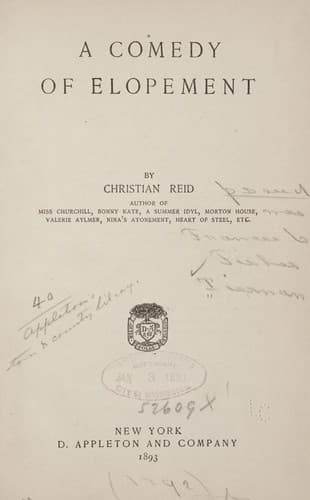
Florida -- Fiction; Man-woman relationships -- Fiction; Young women -- Fiction
He was perfectly calm in outward bearing, but his quietness of
manner did not deceive Fanny for a moment. She knew in the first
glance of his eye that he had come for war, and she felt at once
scornfully ready to meet it. What could Percy Joscelyn say that
would matter to her? She threw back her head and met him with the
weapon that always came to her most readily, that of mockery.
“Why, Percy,” she said, “this is a very unexpected pleasure. It
is not often you are good enough to come to see me alone. But I
suppose you want to talk over such an interesting event as Aimée’s
engagement.”
“Not exactly,” replied Percy, blandly, though his glance became
more venomous than ever. “I do not consider that Aimée’s engagement
can take place without the consent of her parents and guardians;
but I wish to congratulate you on your success in getting rid of an
old lover who might tell awkward stories, by the simple expedient
of stopping his mouth with an heiress.”
There was a moment’s pause. The gauntlet had been flung down, and
he stood with his hand on the back of a chair, waiting to see how
she would take it up. As for Fanny, astonishment rather than lack
of courage held her silent for the short space of time in which
they regarded each other. Then she said, with more dignity than any
one could have imagined her capable of displaying:
“So you have come simply to insult me. That, at least, makes
matters clear. I understand and can allow much for your
disappointment with regard to Aimée; but I do not intend to listen
to such insinuations as you have just uttered. Be good enough to
leave my room.”
She lifted her hand and pointed to the door, but Joscelyn did
not stir. On the contrary, he held his position with an air of
determination, as he held her glance by the steadiness of his own.
“It will not be well,” he said, “for you to insist upon my leaving
before I have finished what I have come to say. I know that Kyrle
was your lover before you were married, and that you jilted him for
a richer man. In order to deceive that man, you have represented
him as having been the lover of Aimée. This is a pretense which
might blind Mr. Meredith, but nobody else; and I hardly think it
would blind _him_ very long if one took the trouble to tell him the
truth. Now, I do not propose that Aimée shall be bargained away to
save your secrets, so I plainly give you your choice: send this
fellow away, as I have no doubt you have the power to do, or Mr.
Meredith shall know the whole truth about him and you!”
“My dear,” said Fanny Meredith afterward, in describing the
scene to Aimée, “I was astonished at myself. You know I always
was a coward, and I had no doubt that the horrid wretch did know
everything, as he said, and would tell it to Tom. But, for the life
of me, I _could not_ quail before him! I felt such contempt for
him, and such a sense of outrage that he should dare to threaten me
in that manner, that I suppose it was anger that made me as brave
as a lion.”
Public-domain text, read in full here on John Shaqi.
Reviews
Reviews
No reviews yet
Be the first to share your thoughts on this work.
Elsewhere in the archive
Join the Discussion
Join the discussion
Sign in to leave a comment or review.
Sign InorCreate an account