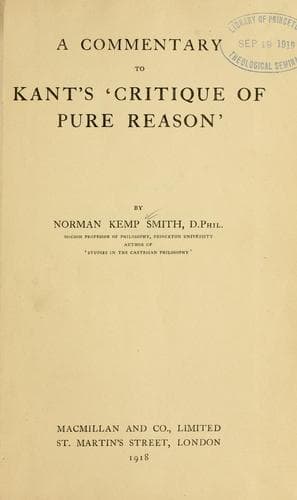
A Commentary to Kant's 'Critique of Pure Reason'Smith, Norman Kemp
Philosophy
A Commentary to Kant's 'Critique of Pure Reason'
Smith, Norman Kemp
Kant, Immanuel, 1724-1804. Kritik der reinen Vernunft
The clash of conflicting tenets which Kant is striving to reconcile
could hardly find more fitting expression than in this assertion of an
_analytic synthesis_. The same conflict appears, though in a less
violent form, in A 438 = B 466.
“Space should properly be called not _compositum_ but _totum_,
since its parts are possible only in the whole, not the whole
through the parts. It might, indeed, be said to be a _compositum_
that is _ideale_, but not _reale_. That, however, is a mere
subtlety.”[412]
The arguments by which Kant proves space to be an _a priori_ intuition
rest upon the view that _space is given as infinite_, and that _its
parts arise through limitation of this prior-existent whole_. But a
principle absolutely fundamental to the entire _Critique_ is the counter
principle, that all analysis rests upon and presupposes a previously
exercised synthesis. _Synthesis or totality as such can never be given._
Only in so far as a whole is synthetically constructed can it be
apprehended by the mind. _Representation of the parts precedes and
renders possible representation of the whole._
The solution of the dilemma arising out of these diverse views demands
the drawing of two distinctions. First, between a synthesised totality
and a principle of synthesis; the former may involve a prior synthesis;
the latter does not depend upon synthesis, but expresses the
predetermined nature of some special form of synthesis. Secondly, it
demands a distinction between the _a priori_ manifolds of space and time
and the empirical manifold which is apprehended in and through them.
This, as we have already noted, is a distinction difficult to take quite
seriously, and is entirely unsupported by psychological evidence. But it
would seem to be insisted upon by Kant, and to have been a determining
factor in the formulation of several of his main doctrines.
Public-domain text, read in full here on John Shaqi.
Reviews
Reviews
No reviews yet
Be the first to share your thoughts on this work.
Elsewhere in the archive
Join the Discussion
Join the discussion
Sign in to leave a comment or review.
Sign InorCreate an account